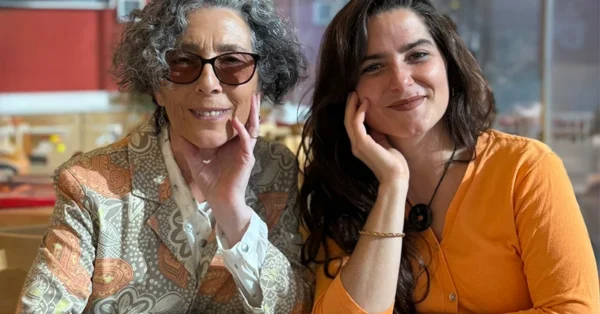
Each patient offers us a learning experience, and they do not realize how grateful we are, those of us who, from therapy, accompany them in their doubts, fears, and blockages. And we are part of their process of mobilizing their best resources.
My clinic focuses on psychogenealogy (the perspective that places the observer on what happened and got stuck in the family tree, and that returns to be managed and stop being a problem in the present), and my books — popular science essays so that psychogenealogy and bibliotherapy are accessible to the general public — bear witness to that practice.
In the latest publication (May 2026), co-authored with Ondi Paris (@ondiparis) the challenge was greater: a writing that bridged emotional management exercises (guides, meditations, access to the symbolic) and the theoretical concepts to open the family tree (birth order ranges, anniversary syndrome, memorized cellular biological cycle, life scripts, the occupant syndrome, replacement child, etc.) with fiction.
Yes, we assume that all theoretical information would be filtered through a fable, because storytelling evokes the most human part of us: the need for another who tells and builds worlds with the word offered to the listener.
From that overlay of plots (psychogenealogy, discovering purpose, visiting the stories of our ancestors, bibliotherapy and the fable in the woods) arose a style that we did not deliberately choose; it co-created with the narrative universe. And we let it flow in anticipation of the reader’s reception.
And here enters the real experience: a specific patient who motivated these lines with his comments. “Living in a gray and noisy city, on autopilot, never pausing to think about what I feel, what I decide, always in a loop seemed natural until I traveled to the forest retreat reading Tu voz que florece. I felt my soul as a child again, listening to a story while reflecting on my family clan, its problems and my current conflicts.” I was moved by his comment.
Bibliotherapy: the hour of healing fiction
When I asked about its reader effect, which he named as “so healing,” I delved into the characteristics of the genre. And naturally he outlined the qualities of a book that aims to be a sanctuary, a map to exit the “loop” that returns to the same wound again and again, a “first aid kit” for an anxiety attack or severe sadness, unconventional medicines that bring peace and suggest a pause to reset daily experiences with a conscious gaze and the capacity to change.
Healthy reading, and I know that from being a bibliotherapist. Now, I also affirm that this genre called “healing fiction” has all the ingredients of a great possibility of holistic healing in times of vertigo and uncertainty.
Whether reading and rewriting a literary fragment where a knot appears to explore alternatives to one’s own problems; whether identifying patterns of behavior and mandates that imprison the freedom to choose (because analyzing the problem of a literary character allows one to see one’s own conflict); or reading poems or specific micro-stories to regulate an anxiety crisis (because the rhythm and meter of certain texts help stabilize the nervous system), literature has always functioned as a resting plank in the waves of emotional chaos.
I recall a book I read in the early 1990s and it revealed what bibliotherapy centers on: not to explain an absolute truth but to unfold a personal and possible interpretation of one’s own human experience through reading myths, legends, and tales. Reading as a tool to ease what hurts and to exercise empathy and compassion. That book was Women Who Run with the Wolves, by Clarissa Pinkola Estés.
Healing fiction hadn’t yet been discussed as a literary style, although psychologist James Hillman coined the theoretical term in the mid-1980s to refer to the role of narration and imagination in clinical psychological practice. He explained how fiction reflects reality and actively reinterprets it.
Healing fiction has no fixed rules; it develops a slow, poetic narrative that rests from information overload. Nevertheless, it is not a self-help read in the sense of a text that provides instructions and wellness formulas to follow.
Its literary style invites embracing an internal process in the presence of the story, letting oneself be absorbed by the reading, in a state of “flow.” That openness helps in adopting a position to re-examine the traumatic events. To look again at the wounds, not so much for the event, but for what each person could do with its consequences: how memory, the body, and the emotions recorded it.
By staging disoriented characters seeking a comforting space to validate their feelings, granting themselves time for introspection, and reaching catharsis, reading functions as an exit from the labyrinth. And, of course, empathy advances thanks to the activation of mirror neurons, and a deep resonance arises in readers who see themselves in action as they follow the paths traced in the fiction.
The 3 “C”
I like to say that this kind of books allows practicing the three “C”: comprehension, commitment, coherence to reach a state flow, or neurotranquility.
- Comprehension
The human experience unfolds with countless nuances that were once unimaginable in one’s life, and narratives broaden the sense of direction, solutions, resources, challenges, and perspective: the motivations and solutions of the characters open new ways to approach one’s own existence. When we understand, we bring relief because we manage to put words where there was once silent pain. How many times have we seen on a page that message, perhaps only one line that seemed addressed to us?
- Commitment
Commitment always begins with me-to-me. From that stance I can commit to general well-being, inspire positive changes, practice habits that bring mental clarity to know when to say “NO” when necessary. And when is it necessary? The answer lies in the ability to connect with one’s own needs. Being able to prioritize ourselves and feel that there is an exercise of self-respect there.
- Coherence
A concept so complex, yet so healing. In the delicate art of aligning what we think, what we say, what we feel, and what we do lies the fullness of coherence. A mental order that serves as emotional refuge and personal consistency: that what we consider the core values of our life are aligned with our actions in a natural way. The fascinating journey of knowing who I am. Always unfinished, provisional, in progress. Unnegotiable for a healthy identity to be built.
In these three qualities lies the heart of self-knowledge, and they frame the type of readings we call healing fiction. They enable what is called the flow state (a state of fluidity), a concept from positive psychology created by Mihaly Csikszentmihályi that describes the optimal experience of total immersion in a task, the balance between challenge and ability, and the release of everyday pressure because it favors mindful attention, concentration, and presence in the here and now.
YOUR VOICE THAT BLOOMS, inaugurates this path of self-knowledge (discovering who I am and what my purpose is) with the invitation to explore ancestral roots, calmly, without judgments, with human rhythm, not artificial, but mammalian: with others, in a tribe, sustained in the open and trusting in the personal path we choose.
Source: Diana Paris is a psychoanalyst, specialist in Psychogenealogy, author of Readings that Heal, Family Secrets, Family Mandates, Women Without Children, Your Voice That Blooms.