

Breast cancer not only presents medical challenges. It also raises an urgent question: how to communicate sensitive, complex, and decisive information in a context filled with myths, false content, and evidence-free promises?
To reflect on this scenario, journalists from different outlets participated in a gathering with professionals from the Alexander Fleming Institute (IAF), Becton Dickinson (BD) and Florencia Ballarino, editorial chief and leader of Chequeado Ciencia.
The event brought together three complementary perspectives: the importance of preventing and detecting the disease early, the advances that enable more precise diagnoses, and the role of communicators in the face of health misinformation.
Breast cancer: separating signal from noise
Dr. Africa Piñeiro, breast specialist and coordinator of the Imaging Diagnostics Service at the Alexander Fleming Institute, addressed the state of breast cancer in Argentina and emphasized one central idea: myths and data do not compete on equal terms.
False content often appeals to fear, hope, or indignation—emotions that facilitate its spread. In the face of that “noise,” medical information needs to be clear and approachable so that women can make decisions with greater confidence.
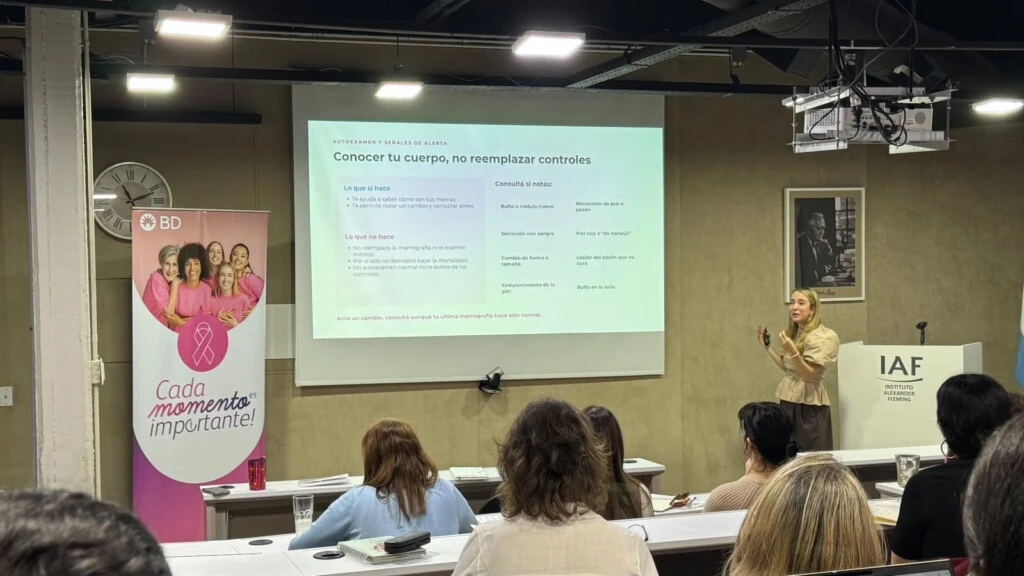
Piñeiro explained that there are risk factors that cannot be modified, such as age, family history, or certain hereditary conditions. However, there are also habits that can help reduce risk: maintaining an active lifestyle, keeping a healthy body weight, reducing alcohol consumption, and not smoking.
The specialist stressed that these precautions do not replace medical checkups. The screening strategy must be tailored to each woman, according to her age, her history, her level of risk, and breast density.
Assessing risk from early ages and agreeing with the medical team when to begin and how often to undergo the studies allows for a personalized follow-up.
Knowing the body does not replace checks
Another key idea was to differentiate knowledge of one’s own body from screening tests. Observing the breasts can help recognize changes and consult upon the appearance of a lump, discharge, skin changes, dimpling, or nipple alterations.
But self-examination does not replace mammography or the checks indicated by professionals. Nor is it necessary to wait until you feel something to seek a consultation: the goal of screening is to detect possible lesions before they cause symptoms.
During the presentation, popular beliefs circulating on social networks were also reviewed, such as that a mammogram can cause cancer, that an ultrasound replaces any other study, or that performing a biopsy can “awaken” or spread the disease. These messages, besides being incorrect, can generate fear and delay consultations.
The most encouraging message was unequivocal: when breast cancer is detected at early stages, survival exceeds 90%.
Timely diagnosis: information and technology to decide better
The second presentation was led by
As she detailed, the choice of procedure depends on the lesion, the method by which it was identified, its location, and the individual patient’s characteristics. Biopsies can be performed with ultrasound guidance, mammography guidance, magnetic resonance imaging, or contrast-enhanced mammography.
Among the tools available is vacuum-assisted biopsy, which allows obtaining a larger amount of tissue and reducing the possibility of insufficient results or false negatives in certain cases. There are also procedures that, for selected benign lesions, can avoid conventional surgery.
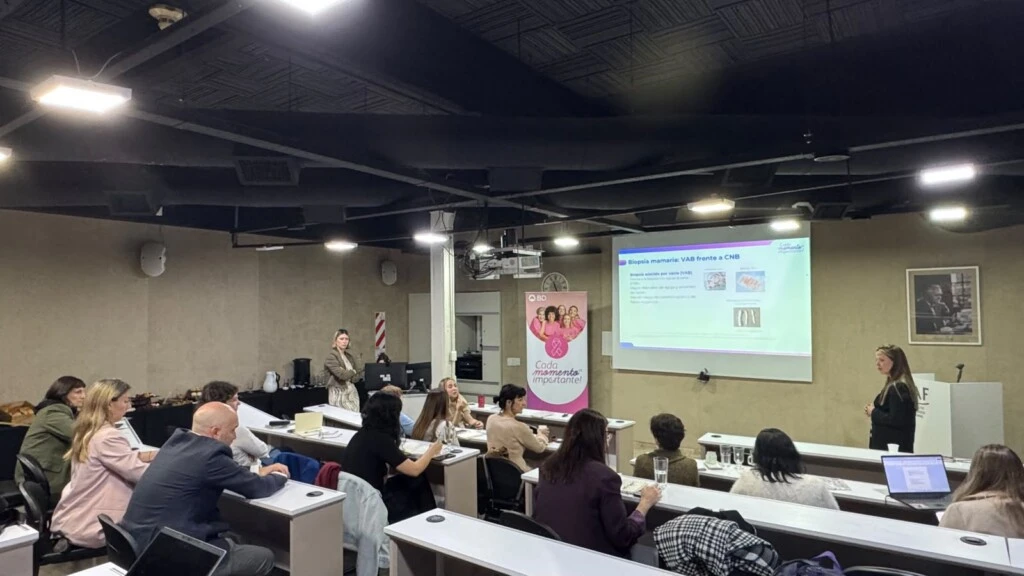
Technological progress is not aimed at replacing professional judgment, but at providing more complete information to make better decisions. Artificial intelligence, for example, can function as a second look in image interpretation, always accompanied by specialists.
The impact also reaches patients: less invasive procedures can be performed on an outpatient basis, with local anesthesia, small incisions, and a shorter recovery.
Health misinformation: a problem with real consequences
Journalist Florencia Ballarino, head of communications at Chequeado Ciencia and president of the Argentine Network of Scientific Journalism, presented an overview of health misinformation in the era of artificial intelligence.
It is not only about incorrect posts. Misinformation can cause someone to delay a consultation or diagnosis, reject a treatment, turn to evidence-free remedies, or navigate the process with greater anxiety and confusion. It also erodes trust in professionals, institutions, and scientific knowledge.
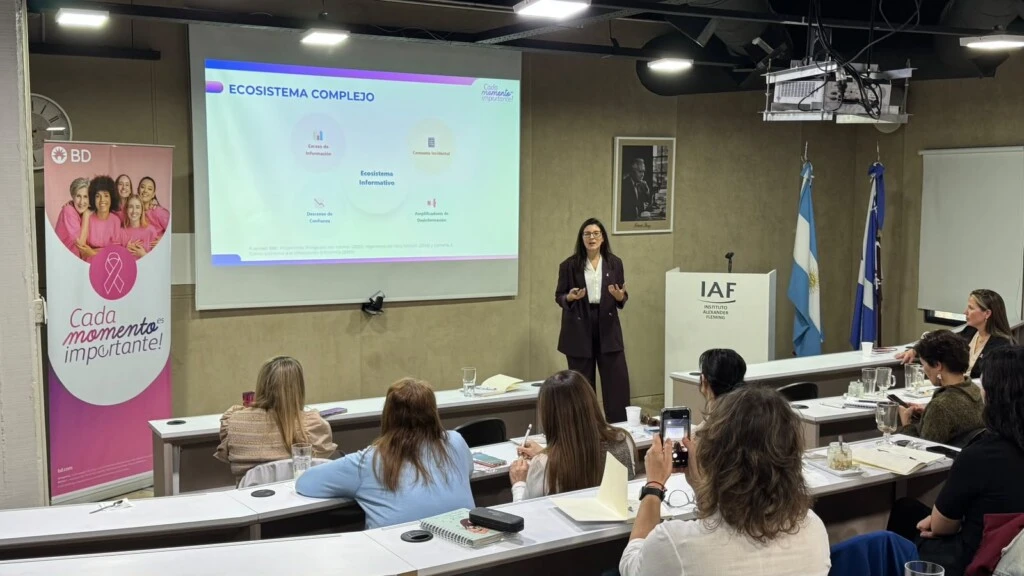
In the case of cancer, content circulates that attributes the disease to a single cause, promises “miraculous” prevention methods, exaggerates the results of a study, or presents personal testimonials as if they were scientific evidence.
Added to this scenario is artificial intelligence, capable of generating videos, audio, and fake images that are increasingly difficult to recognize. When these pieces reproduce the appearance or voice of supposed specialists, they can acquire dangerous credibility.
How to communicate with rigor without losing empathy
Facing this landscape, Ballarino proposed working with three tools: media literacy and health literacy, prebunking and debunking.
Literacy helps learn to evaluate sources, recognize conflicts of interest, differentiate evidence from opinion, and understand how our own biases influence which information we believe.
Prebunking —or the “inoculation theory”— consists of explaining in advance how manipulation strategies work so that people can recognize them before encountering them.
Debunking is applied when false information is already circulating. To effectively disprove it, it is not enough to simply state that something is false. It is necessary to listen without judgment, acknowledge the person’s concern, explain what is known, admit what remains uncertain, and offer reliable sources.
Because communicating about health also requires understanding fear, anxiety, and the need to find quick answers that may lie behind a consultation.
“Fighting health misinformation is not only about discrediting what is false, but also about making people trust more in what is true,” was one of the conclusions of the meeting.
The day thus left a shared lesson among specialists and journalists: a precise diagnosis is the starting point to make better decisions, but clear, responsible, and empathetic communication also forms part of care.