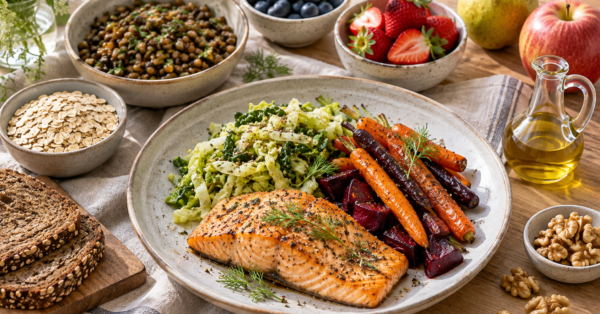
Eating more vegetables, choosing whole grains, and giving legumes and fish their place in the diet. The Nordic diet proposes a way of eating based on everyday ingredients, with simple preparations and variety.
Inspired by the traditional foods of Northern Europe, this pattern also attracts scientific interest. An analysis of more than 64,000 Swedish adults linked it to a lower estimated mortality over 24 years. Although the result does not prove that this diet by itself extends life, it adds to evidence about the importance of sustained eating habits.
What does it consist of and how can we incorporate its principles with the products we find at the greengrocer, the supermarket, or the market?
What is the Nordic diet
The healthy Nordic diet draws inspiration from the eating patterns of Denmark, Finland, Iceland, Norway, and Sweden. Its characteristic ingredients include oats, rye, apples, pears, berries, root vegetables, and fatty fishes.
Like the Mediterranean pattern, it gives prominence to plant-based foods and unsaturated fats. The difference lies mainly in the region-specific products: in Nordic cuisine, for example, rapeseed oil (canola oil) is commonly used.
The nutritional recommendations of these countries also prioritize legumes, nuts, and whole grains, while advising reducing processed meats and foods with high salt, sugar, or added fats.
What to eat: the main foods of the Nordic diet
The foundation is a combination of food groups. Here are its main choices.
Oats and other whole grains
Oats and rye have a prominent place, along with other whole grains. The principle is to replace part of refined cereals with whole-grain versions.
In everyday cooking, this can translate into a breakfast with oats, whole-grain bread toast, or preparations that incorporate barley.
Varied vegetables
Carrots, beets, and cabbages are common in the region. Leafy greens and potatoes are also included.
For a local adaptation, we can add pumpkin, cabbage, broccoli, chard, and other seasonal vegetables. The variety allows you to craft different dishes without relying on a single ingredient.
Fruits and berries
Apples, pears, and berries are part of this pattern. On our table, the fruits available in each season can fill that role: from an apple or a pear to strawberries when they’re in season.
Legumes
Lentils, beans, and peas allow more space for vegetable-based preparations. They can be incorporated into salads, soups, stews, or homemade burgers.
Fish
Fatty fishes, such as salmon, herring, and mackerel, are characteristic of Nordic eating. To translate this idea into local cooking, you can choose available options that fit your budget.
Nuts and vegetable oils
Nuts and vegetable oils form part of the sources of unsaturated fats. The Nordic recommendations propose that these options replace part of butter and other sources of saturated fats.
Which foods does it propose to reduce
In addition to incorporating variety, this model suggests reducing the usual presence of cold cuts, processed meats, and foods with excess salt, sugar, or added fats.
It also recommends replacing refined cereals with whole grains and reducing red meat consumption, giving more room to legumes and fish. These changes aim to improve the overall quality of the diet.
How to incorporate its keys into your diet
An Argentine adaptation can start with familiar, accessible, and seasonal ingredients. These ideas translate the Nordic diet’s general principles into everyday meals:
- In breakfast: prepare oats with milk or natural yogurt and fruit, or choose whole-grain toast.
- At lunch: add lentils or beans to a salad with vegetables.
- In the afternoon snack: combine a fruit with natural yogurt or a handful of unsalted nuts.
- At dinner: prepare fish with vegetables baked in the oven, a legume stew, or a soup with vegetables and barley.
- When cooking: use vegetable oils in suitable preparations and alternate the usual side dishes with more vegetables.
These proposals are examples of local adaptation, not a menu proven by research. They follow the Nordic recommendations: more plant-based foods, whole grains, and better fat sources.
What the study found about the Nordic diet and longevity
The study, published in The American Journal of Clinical Nutrition, analyzed data from 64,406 Swedish men and women of middle and older age.
Researchers used information on diet and other factors collected at different times to estimate what might happen over 24 years under three scenarios: maintaining a healthy Nordic diet, following the 2023 Nordic Nutrition Recommendations, or continuing without a specific dietary intervention.
The model estimated that the healthy Nordic diet was associated with an all-cause mortality risk 2.67 percentage points lower than the intervention-free scenario.
However, it was not a randomized trial. Observational data and a statistical simulation were used, and the results depend on assumptions and may be affected by unmeasured factors.
Additionally, the study’s main aim was to evaluate serious liver complications, and in that respect, a conclusive reduction in risk was not found.
The appeal of this pattern lies in the combination of foods and its continuity. The study does not allow attributing the outcome to a single ingredient, such as oats or salmon. To bring its principles to our table, we can start with concrete changes: add more vegetables, cook legumes more often, and choose whole grains.