
There is something that has become increasingly difficult in our daily conversations: listening to someone who thinks differently without feeling that we have to defend our own ideas.
It happens at family dinner tables, among friends, at work, and also in public discussions. Too often we are used to interpreting the other’s words through our own beliefs, without stopping to understand what lies behind their perspective.
However, have we really lost the ability to come together?
A fact invites reflection. According to the report Argentines, Polarization, and Daily Life, conducted by Pulsar.UBA in 2025, 74% of respondents reject judging others for their political ideas and 68% could be in a relationship with someone who thinks differently.
These results show that, beyond the disagreements that traverse our society, there remains a willingness to live with differences.
Perhaps the true challenge is not to think alike, but to value what each person can contribute from their own perspective.
The Pope’s Visit and the Value of Reconnecting
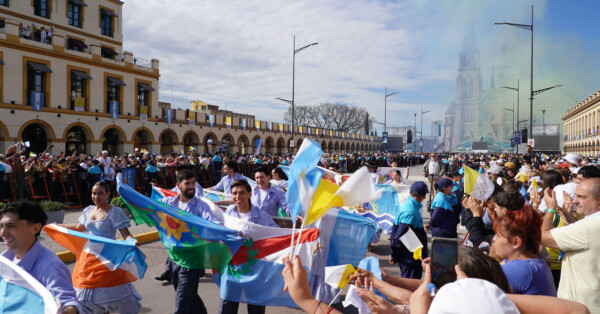
The visit of Pope Leo XIV to Argentina, from November 8 to 11, gave us an opportunity to reflect on something that transcends religion: the importance of coming together and the need to reclaim what unites us as a society.
A gathering of this magnitude invites us to ask what moves us as a community, what shared hopes we hold, and how we can build bonds beyond our beliefs, histories, and convictions.
Faith can be expressed in many ways. For some, it is linked to religion; for others, to certain values, projects, or the belief that a better future is possible.
In any of its forms, belief means finding meaning, sustaining hope, and recognizing that new possibilities always exist.
We do not need to share the same religion or think identically to understand what it means for thousands of people to mobilize around a shared hope.
The real question is whether we can translate that willingness to come together into our everyday lives.
Listening Does Not Mean Agreeing
From ontological coaching we start from a fundamental premise: each person observes and interprets the world from their own history, experiences, emotions, and beliefs.
In the face of the same situation, two people can have completely different interpretations. And that does not necessarily mean that one is right and the other wrong.
The problem appears when we confuse our interpretation with an absolute truth. When we believe that our view is the only possible one, we stop listening and begin to defend ourselves.
Understanding the other does not mean agreeing with them. And dialoguing does not entail giving up our convictions.
It is about recognizing that our perspective is one among many and that behind every opinion there is a story worth listening to.
Sometimes, the first step to transforming a relationship is not finding the right words, but learning to listen in a different way.
Building Bridges Is Also a Daily Decision
Argentina is undergoing economic, social, and cultural transformations that create uncertainty for many people.
When we don’t know what comes next, we seek certainties. And in that search, differences can become a source of tension.
However, we can also choose another path.
Uncertainty does not have to paralyze us. It can become an opportunity to review our beliefs, broaden our view, and find answers we hadn’t considered before.
Often, the most important changes begin with small gestures: a conversation we avoided, a sincere question, the decision to listen without interrupting, or the chance to recognize something valuable in someone who thinks differently.
Building bridges does not mean avoiding conflicts or pretending that everyone agrees.
It means learning to sustain differences without breaking ties, listening without disqualifying, and finding possible agreements even when there is no absolute coincidence.
The Argentina We Need Begins in Our Conversations
The Pope’s visit leaves us with a question that deserves to endure far beyond the days of his stay: what are we willing to do so that the encounter is not merely an extraordinary event, but a daily practice?
Restoring trust in our ability to build a shared future is not the exclusive task of leaders or institutions.
It also begins with each of us, in our conversations, in our decisions, and in the way we choose to relate to others.
We don’t need everyone to think the same to recognize ourselves as part of one society, with common responsibilities, challenges, and possibilities.
Perhaps the first step is to stop looking at the other as someone we must convince and start recognizing them as someone with whom we too can build.
Because bridges are not built when differences vanish, but when we decide that those differences do not have to separate us.
And even in times of uncertainty, we can always choose how to move forward.
Source: Susana Nuevo, a professional ontological coach and leader of the Society Line of the Argentine Association of Professional Ontological Coaching (AACOP).