
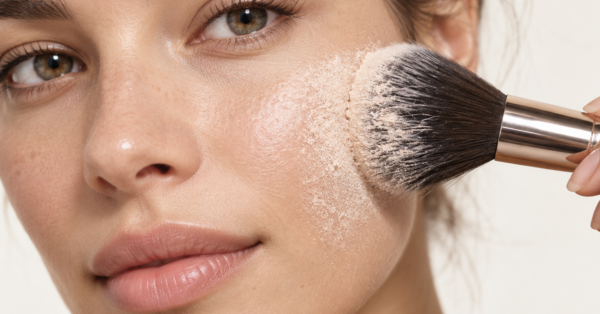
What is volatile powder, how to choose it based on your skin, and where to apply it to control shine without losing radiance.
For years, the goal was to achieve skin that looked increasingly luminous. Luminous foundations, liquid highlighters, and creamy products built the so-called glass skin effect. But makeup in 2026 is beginning to seek another balance.
The trend known as blurred skin proposes a diffused, velvet-like complexion with less shine, though not returning to the completely matte face of other decades. The finish sits halfway between matte and luminous: it controls certain areas while preserving freshness in others.
In this context, volatile powder regains prominence. Its return does not mean applying it generously over the entire face, but learning to use it with precision.
What is volatile powder and what is it for
Volatile powder is a loose, very fine-textured product primarily used to fix makeup. It is applied after foundation and concealer to minimize their movement and help them last longer.
It also helps control shine, visually soften the appearance of pores and texture, and prevent cream products from gathering in creases.
It should not be confused with a powder foundation. Volatile powder offers little to no coverage: its main function is to set and mattify. It is also not exactly the same as a pressed compact, which comes pressed, is more practical to carry in a purse, and is usually easier for touch-ups.
Is matte skin really coming back?
Yes, although it does not bring back rigid, heavy, uniform matte. The current trend seeks a soft-matte or soft-focus effect, capable of reducing excess shine without erasing the face’s natural dimension.
The skin is mattified selectively. The forehead, the sides of the nose, the chin, and some areas under the eyes can look more polished, while the cheekbones and temples maintain a subtle luminosity. Makeup artists describe this result as a balance between reflection and control.
Therefore, rather than returning to “powdering” the entire face, the major change lies in working each area according to its needs.
How to buy the right volatile powder
Before choosing it, it is advisable to look at three aspects: skin type, finish, and shade.
For oily skin, a mattifying formula can work to help absorb excess oil. If there is also a tendency toward acne, it is recommended to look for labels like oil free and non-comedogenic.
For dry or mature skin, opt for an ultrafine, light, and flexible formula. The product should be applied only where needed, because too much can cling to dry areas or make expression lines more visible.
Combination skin can use it on the T-zone and leave the cheekbones free. This controls shine without completely dimming the entire face.
As for color, there are two major possibilities:
- Translucent: sets without trying to add coverage. Still, “translucent” isn’t always universal: some products come with variants for light, medium, and deep skin.
- Tinted: includes pigments that can match the base shade, visually neutralize a specific area, or provide a luminous effect.
When buying it, the ideal is to choose a variant close to your skin tone and undertone. It is also wise to check that the formula is labeled as suitable for photography or flashback-free, especially if it will be used at events: some powders can leave a whitening veil when exposed to strong flash.
How to apply volatile powder step by step
Skin preparation is fundamental. First apply moisturizer and sunscreen; then foundation, concealer, and cream products. The powder comes at the end of that stage to set them.
Place a small amount on the cap of the container. Load the brush, the swan brush, or the sponge, and remove the excess very well. It is preferable to start with a little and add only if necessary.
The tool changes the result:
- Large, loose brush: leaves a light, natural veil.
- Small brush: allows work around the nose, chin, or targeted areas.
- Swan brush or sponge: deposits more product and provides greater fixation. Instead of dragging, gently press onto the skin.
For a current finish, apply it in the center of the forehead, the sides of the nose, and the chin. If concealer tends to settle under the eyes, you can place a minimal amount with a small brush, without covering the entire area indiscriminately.
How to use it according to each need
If you want to extend the makeup wear, press a thin layer over the areas where the foundation tends to move. To control oiliness, concentrate the product in the T-zone.
On dry or mature skin, avoid powdering the entire face. A localized application around the nose, at the center of the forehead, and, if needed, around the mouth is usually enough. Leaving the cheekbones unpowdered helps maintain a fresh appearance.
It can also be used without foundation, directly over sunscreen or a tinted cream, as long as those products have settled. In that case, the goal is to reduce shine and visually even out texture.
Mistakes that can ruin the result
The most common mistake is using too much product. If the powder remains visible on the skin, there is likely an excess. It can also harden features when distributed uniformly, without differentiating dry areas from those that produce more oil.
Another mistake is applying it to dehydrated skin or before the foundation has set. Instead of blending, it can form small patches.
To touch up during the day, first remove the oil from the face with an absorbent sheet, pressing without rubbing. Then apply a minimal amount of powder. Layering directly over shine can produce a heavy texture.
Baking, which involves depositing a heavier layer and removing it after a few minutes, can be useful for long-wear makeup, but it is not essential for everyday use. For a natural effect, one thin, strategically placed layer is enough.
The secret of today’s matte skin
Volatile powder returns, but its application has changed. It is no longer about eliminating every reflection, but about deciding where we want luminosity and where we need greater fixation.
A small amount placed correctly can prolong makeup, soften shine, and create that diffused effect that defines the trend. The key lies in choosing a suitable formula and remembering a simple rule: it’s always easier to add a little than to remove excess.
