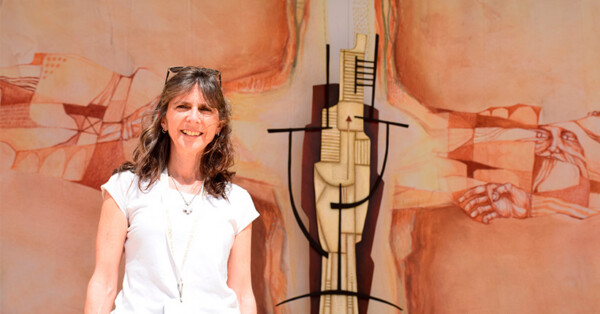
There are moments in life that seem to gather, in a single instant, all the paths traveled. Childhood dreams, decisions that shaped a destiny, the people who walked with us and also those who are no longer here. For Vero Soncini, that moment arrived when she saw the Pilgrim’s Cross rise, for the first time, on the stage where Pope Leo XIV would meet thousands of young people.
The sculpture, four meters tall by 1.80 meters wide, was far more than a work of art. It was an invitation to walk, to rise after falls, to connect with others and to discover that even on the toughest journeys a light can still appear.
Everything had begun at the end of August, with an unexpected call from Father Ignacio Díaz. A proposal that moved her deeply and led her to embark on one of the most meaningful projects of her career.
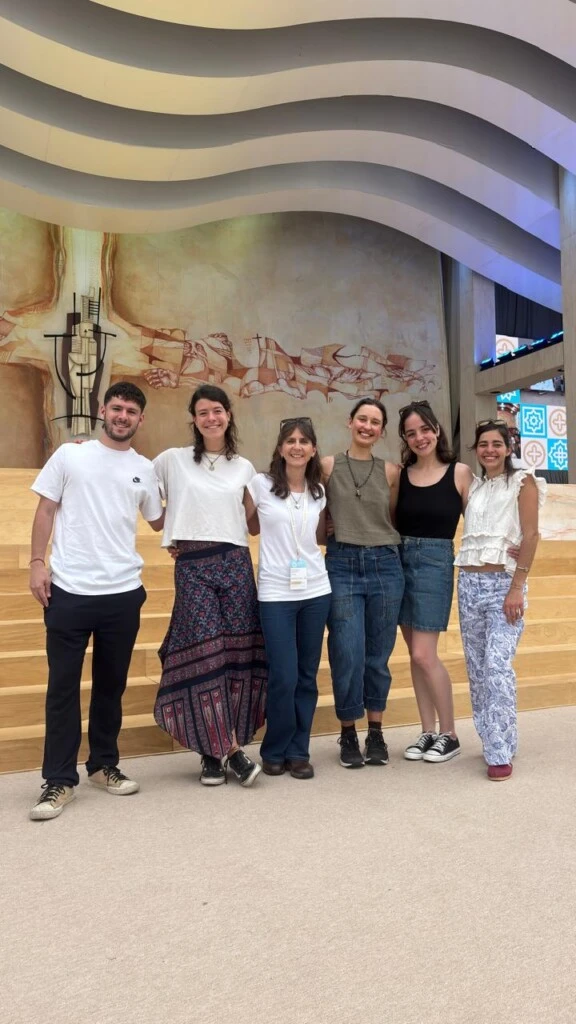
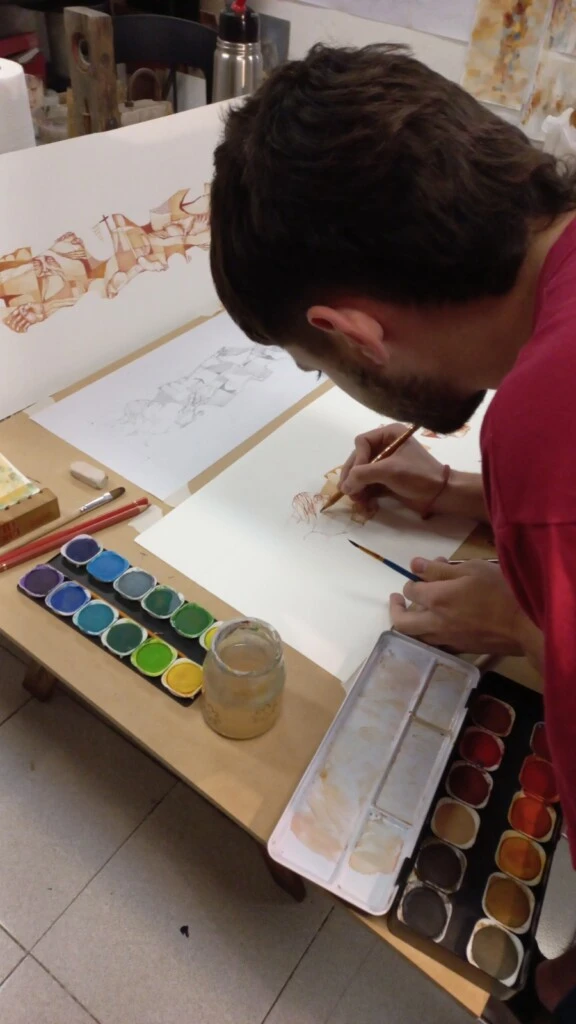
For two months, alongside a team of young artists, she worked to turn an idea into monumental scenography. There were sketches, tests, conversations, endless days, and even an afternoon when they kept working by candlelight because the electricity had gone out.
Yet behind every stroke there was something deeper: a personal story, a spiritual search, and the conviction that art can become a bridge between the human and the sacred.
Wife, mother of three, artist and teacher, Vero speaks of this experience with a passion that still seems to overflow. She recalls her father, who died this year, a priest who marked her life, and the teachers who helped her find her own artistic language.
In this interview with Para Ti, she opens the doors to that creative process and shares how a cross born from her hands ended up becoming an image that many felt as their own.
“I felt I was being called to an important mission”
—How did the call come, when you were asked to create the stage art for the Meeting of the Youth with Pope Leo XIV? What was the first thing you thought when you were summoned?
—At the end of August I received a phone call from Father Ignacio Díaz, whom I’ve known for many years, since I was a seminarian. He proposed that I work in the visual arts for the Pope’s stage.
It was an unexpected call that filled me with emotion. I felt so chosen… Of course, I immediately told him yes, that he could count on me for whatever. We agreed to meet the following week to start planning.
It was something very unexpected, filled with light. I truly felt that Father Ignacio Díaz was an instrument and that I was being called for an important mission. A mission that would try to touch hearts.

—You say that it all began with a Gospel passage and the message “Take heart, rise.” What image came to mind when you read it, and how did it end up taking shape in the Pilgrim’s Cross?
—One of the first things I was told was that the entire gathering would be based on the Gospel passage of Bartimeo, a blind beggar who was by the roadside as Jesus was going toward Jericho.
Bartimeo wanted to get closer to Jesus, but people pushed him aside, despised him for his disability and for being a beggar. He cried out to gain his attention and others tried to push him away. But Jesus stopped, called him, and asked what he wanted. Bartimeo replied that he wanted to see. Then he regained his sight, left his beggar’s cloak, and began to follow him.
I read that passage seven or eight times. I repeated it with cadence, with rhythm, because I believe that in that way one becomes more permeable to the deeper meaning of the words.
That reading awakened in me many images. I understood that the message was an invitation to join Jesus’ path. And when they told me the motto would be “Take heart, rise up,” I understood that this was what we had to convey: we were all invited to rise up and join that great journey.
The staging has two senses. The horizontal dimension represents all of humanity, with people helping each other, joining hands, and supporting one another. That entire movement travels from the edges toward the center, drawing nearer to the path of light.
The vertical sense unites the earth with the sky. It has an ascending reading, like an offering of humanity to God, and a descending one, which represents God’s gaze that seeks us out and lifts us up.
In the meeting of those two paths, the Pilgrim’s Cross appears.
“We are all walkers: there is an individual path and one we make together”
—Why did you call it the Cross of the Pilgrim? If we approach to look at it, which detail would you like us to linger on?
—I named it the Cross of the Pilgrim because it represents the personal path we travel from birth to death.
It is a journey that has missteps, accidents, difficulties, but that also lifts us.
It’s important to distinguish the Cross of the Pilgrim from the entire staging. The cross is the central piece, a sculptural and pictorial ensemble suspended in front of the curtain. It is the symbol of the meeting between the path of humanity and the path that unites the earth with the sky.
In that piece there are two dark shapes that represent human figures supporting themselves and clinging to a central luminous form. That form is built from fragments, cuttings, steps and accidents.
There is a rhythm of lines that begins by tracing the curvature of the Earth, ascends, becomes a cross, forms a chalice, and also a staircase that leads us to the sky.
That whole path of light, which is Christ, gathers us and helps us walk in the search for holiness.
For me there is something very important in that union of earth and sky. I speak of harmony, but not a flawless perfection. I speak of a harmony in which the divine is in the human and the human is in the divine.
Always intertwined.
All of us are walkers. There is an individual path, which each person makes from within, and there is also a communal path. And that shared path was something that was very evident during these days.
The work with five young artists: “Unity had to be above individuality”
—You gathered five young artists ( Facundo Aramayo, Pilar de Notta, Juana Tomas, Luz Ocampo
and Vicky Dufourq) to create a work that would be at the center of a gathering with other youths. How did you choose them and what did they contribute that changed your initial idea?
—The proposal to form a team of young people came from the event organization. All the teams were led by someone with experience and a track record, but composed of young people. This happened with the choir, with the choreographies, and also with our team.
I invited young people who had just graduated, others who were starting their careers, and some who were still studying art.
I looked for people with a lot of desire to work, with willingness to adapt, to be flexible and to offer themselves. And it was also essential that they had a lived faith, because we needed to deeply understand what we wanted to convey.
It couldn’t come from intellect alone or from rational knowledge. We had to incarnate it, pass it through our own bodies and our hearts.
That is how a wonderful group came together.
The general idea, the frontal approach, the symmetry and the overall design of the piece were mine. But then began a rich workshop process, where each contributed their explorations and their proposals.
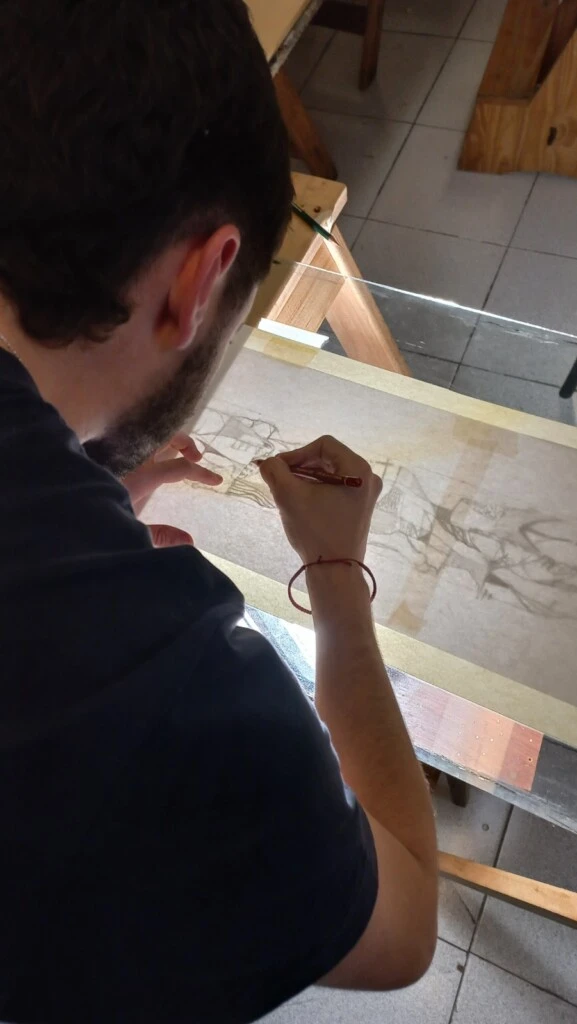
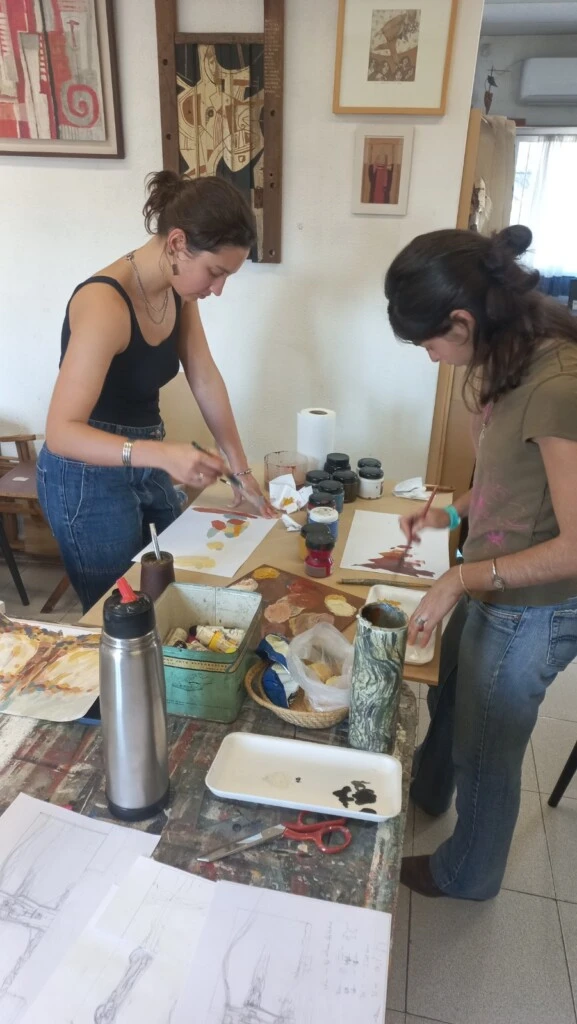
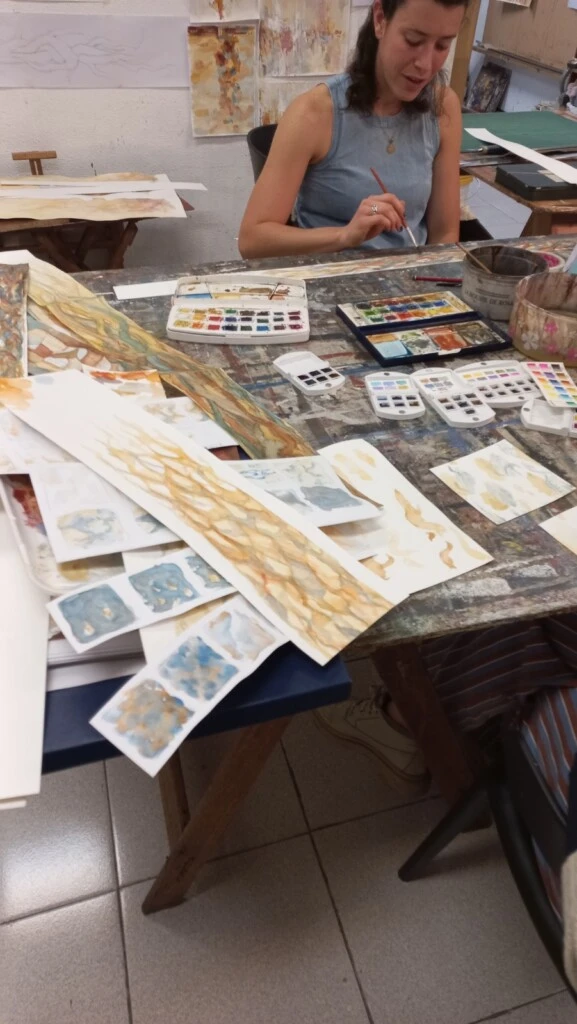
For example, the paths created on the two platforms at the base of the stage were intended to represent a journey from darkness toward light. To reach the final resolution we produced fourteen sketches.
Each person worked on different versions, and then we had to discover what worked within the whole.
Because when you work as a team there is something fundamental: unity must be above individualities. Nothing anyone does can harm another’s work.
There were countless tests, corrections and dialogues. I accompanied the entire process: here we needed to soften the contrast, here more line was needed, this was too harsh…
There was also a lot of work on the designs that would later appear on the screens.
Facundo Aramayo, for example, produced many models to find a way to intertwine the figurative with the abstract. We wanted people to recognize hands and faces, but for those images to integrate harmoniously into the abstract proposal.
It was a process of immense exploration, until everything had the same rhythm.
From a small model to a monumental work: “I only understood its presence when I saw it mounted”
—What was the hardest part of taking a sketch a few centimeters wide to a wooden cross four meters by 1.80 meters? Was there anything you could only see when it was in front of you, full size?
—Working at scale involves a lot of mathematics. There is always a difference between a small work and a large one, but imagine dealing with a piece of such dimensions.
There was a lot of anticipation to see how everything we had worked on in sketches and models—none larger than about a meter—would look.
The Pilgrim’s Cross was a piece I created personally. First I did many drawings, until I defined its shape. Then I worked in color and built a small cardboard model, about fifteen to twenty centimeters, to imagine its three-dimensionality.
Only then did I move on to the real measurements.
When you work correctly to scale, the image is reproduced, but something you cannot fully anticipate happens: the monumentality it acquires when placed in the space.
That is something I could only understand when I saw it installed on the stage.
“We spent two hours working by candlelight: one of the most beautiful moments”
—You said that one day the power cut and no one moved. You called it “two hours like Rembrandt.” What were you trying to resolve at that moment, and how did you manage to keep going?
—We held many workshop sessions and it wasn’t always easy to coordinate everyone’s schedules. Sometimes three could come, sometimes two, and when all five were together it was almost a miracle.
One day there were several of us working and the power cut out. At first we thought it would come back right away, but it started getting darker and it didn’t return.
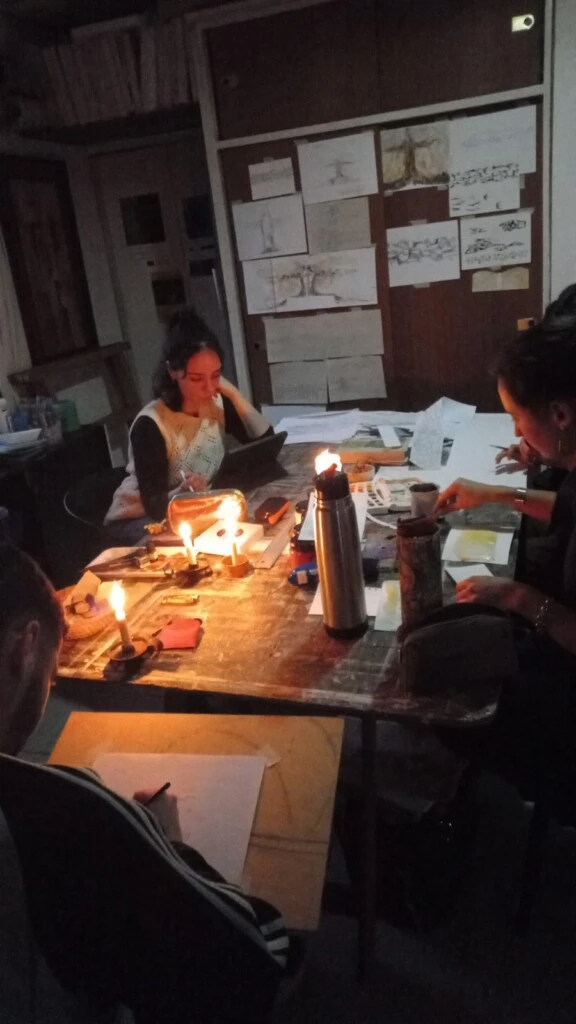
Then I said: “Well, what do we do?”
We searched for candles, lit a portable emergency light, and kept working.
I thought it would be only a little while, until the electricity returned, but we stayed for two hours like that, illuminated by candlelight.
It was moving.
We were just starting, everyone was deeply engaged in a profound personal quest. We had already defined some roles and had to move forward with the originals.
There were parts that had taken us up to fourteen models to reach a resolution, and then we still had to produce the final one.
We didn’t have much time and there was a lot to do.
But no one wanted to leave. We kept working.
For me, it was one of the most beautiful moments we shared.
“I felt very small beneath my Cross and beneath the arms of all humanity”
—After so many hours in the workshop, what did you feel when you saw the cross at the center of the stage during the meeting? Who did you think of in that moment?
—The first moment of enormous emotion came during the installation, on day 9, after Mass.
That afternoon they began to dismantle the space that had been used for the celebration. They removed the altar, the lectern, the cross that stood behind it, and some side curtains. They began preparing the stage for the meeting the next day.
I could go up, walk through that space, and understand its dimensions with my own body.
The mounting was carried out by a production company, but I was there guiding the process.
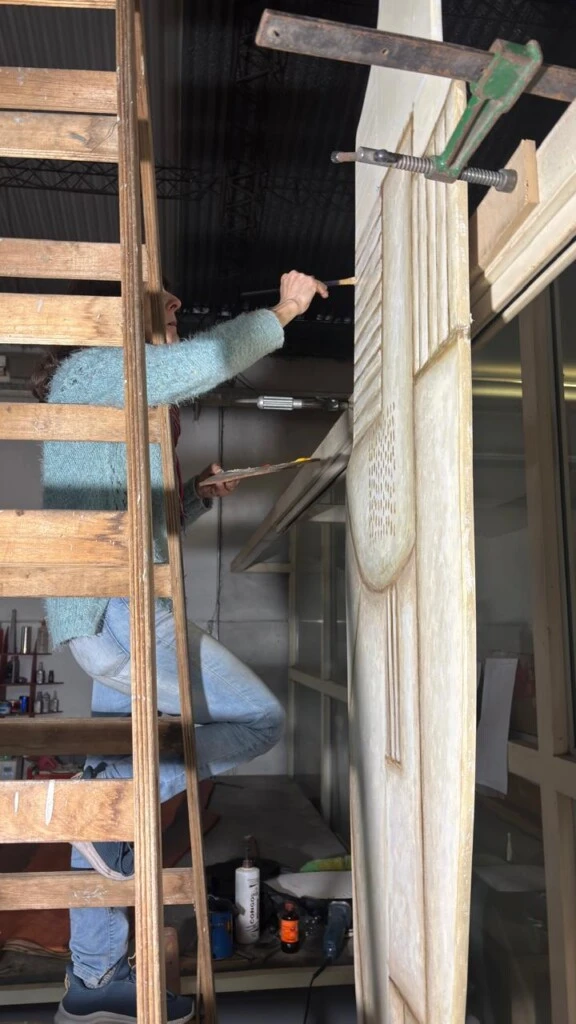
When they began to raise the curtain and then the Pilgrim’s Cross, it was something impressive.
I had never seen it in those dimensions.
It rose, and I cried. I gave thanks and understood how powerful what was happening was and also what was to come.
The piece acquired a monumental presence that was in my intention, but I could only verify it at that moment.
I saw myself as very small beneath my Pilgrim’s Cross, beneath the arms of all humanity.
The next day, with the presence of the youths, the dance, the music and finally the arrival of the Holy Father, the emotion was even greater.
I cried a lot.
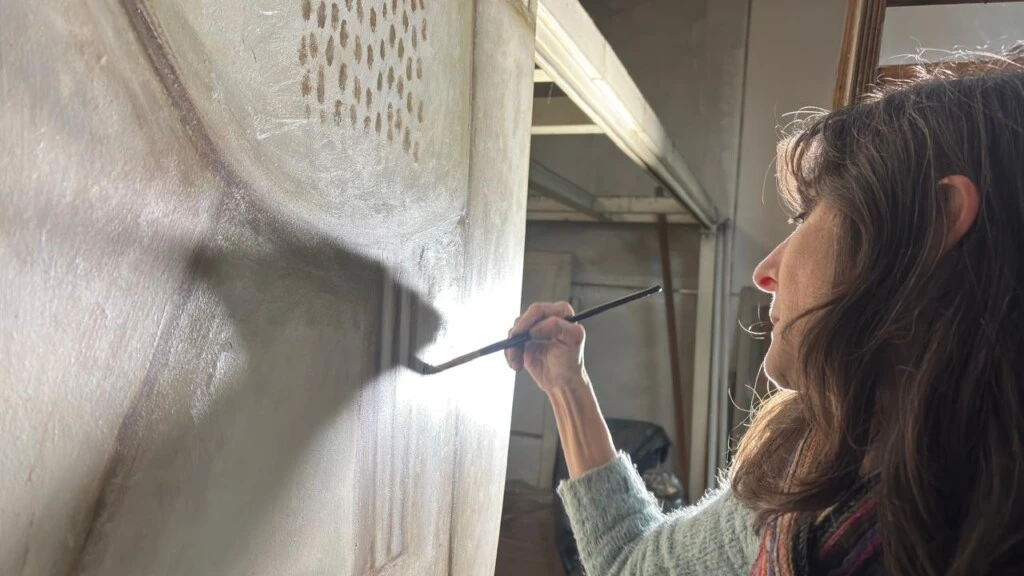
Memories from my entire life came back, of when I felt my artistic vocation so deeply. I thought about how happy I was to have chosen this life as an artist, never knowing where it would take me.
I also thought of people who are very important to me.
One of them was Father Eduardo Graham, who died two years ago. I met him twenty years ago, and from the first moment he understood my work. We shared a view of art as an incarnation of the sacred.
We worked a lot together. He accompanied many of my exhibitions and I participated in many of his projects. I felt him very present. I imagined he would have been very happy to see all of this.
I also thought of my father, who died this year and did not get to see it. I wished so much to tell him! I am sure he saw it from wherever he is.
I recalled my art teachers who left deep marks on my formation: Gustavo de María, at the start; Osvaldo Dubati, who was a paternal guide on my artistic path; and Alberto del Monte, who especially shaped my conceptual work.
And, of course, I thought of my family.
I am a wife and mother of three. They were all present in that work. Their company, their support, their appreciation.
It was my offering; it was my life.
I believe there are countless people lifted up on that cross. I lifted them all up.
Because my hands, my heart, and my mind can create a work, but when it becomes a symbol, it carries with it a life. A life of mine and the lives of all the people who accompanied me.
“They told me they felt the arms of the cross embracing them”
—Did any reaction from the youths who saw the work stay with you? Did anyone tell you something that made you see it differently?
—It was wonderful what began to happen.
Before the meeting began, many people came to the stage to take photos with the piece. It was impressive. Everyone wanted to have an image with the cross in the background, as if you’re visiting a remarkable landscape and want to photograph yourself there.
For me, it felt like watching a movie.
At one moment a video appeared on the screens where I explained the meaning of the work. Since I have many years of teaching activity, later I received videos from my students shouting and applauding in front of the screen.
There were also people who approached me and said: “Did you do this? I can’t believe it.”
But the most exciting came later, with the messages.
Many people wrote to me. People who had my number called me, crying, deeply moved.
And then something happened that, for me, is fundamental in art: the work began to acquire new meanings based on each viewer’s personal experiences.
One thing is the intention you place as a creator, but after that each person adds their own experiences, memories, and sensitivity.
Some told me they had seen Bartimeo’s face in the drawings on the scenography. Others claimed to discover Christ’s face in the cross, though it is an abstract piece, a sign.
One person told me: “I couldn’t stop looking at it. I felt that cross, those arms of the cross were embracing me.”
Another told me that the light attracted her in such a wonderful way that she felt the urge to approach it.
I received truly moving messages.
And that makes me give thanks to heaven, because I feel the work could awaken very deep fibers in people.
It’s marvelous when the meaning of a creation multiplies and ceases to belong only to the one who made it.
What will happen to the Pilgrim’s Cross after the meeting with the Pope?
—Now that the meeting has ended, what will happen to the Pilgrim’s Cross? Is it already defined where it will stay or if it will travel to other communities? Where would you like to see it again?
—It’s still very recent and we’re still planning a lot of things.
What I can say is that the work will not be kept tucked away.
We will soon announce where it can be seen and surely it will be part of different proposals.
“Walking together is better because it builds community”
—When you say “How beautiful walking is… and together, better,” what moment from these two months comes to mind first?
—Walking is a theme that runs through all my work. It did not start with this project.
In 2014 I held an exhibition called Walking Stories. It’s a theme that has always accompanied me.
For me, walking means making decisions, moving forward slowly, finding one’s own rhythm. I like to talk about testing the waters, but not as something imprecise, rather as a way to stay connected to reality, to feel what happens and decide our next steps.
My work has movement, but a slow movement, because it is the movement of inner growth.
Growth requires reflection, a lot of reflection, but it also requires not stopping to walk.
When you stop, nothing happens.
I believe you don’t have to think all the time before acting. You have to keep doing, because doing also triggers thinking. Hands think.
When we work with our hands, our thinking becomes increasingly deeper.
To that individual path, this work adds the path of all humanity.
And there appears something that, for me, is essential: walking together is better because it builds community.
I have taught for many years and always seek that each project includes children, parents, and grandparents. That art accompanies pastoral work and that pastoral work accompanies art.
I deeply believe in a pedagogy of relationships, in the importance of weaving society through respect, love, acceptance of others, flexibility, and differences.
All of that is what appears in the arms of this enormous cross on the staging.
They are the small parts of a community that come together, sustain each other, and approach the light together.
Because Jesus’ message is that light that always invites us to seek the best.
And that is, in the end, the invitation of the Pilgrim’s Cross: to keep walking, but never forget that we can do it together.