
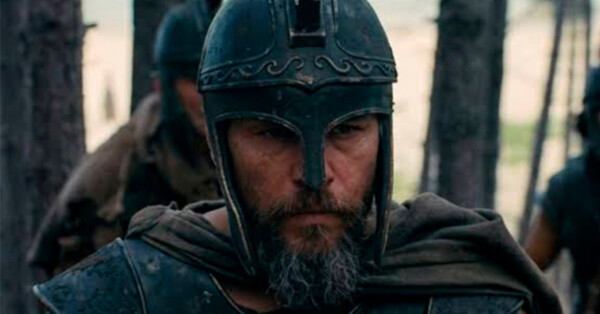
This is not a film review (there are many good ones), but a proposal to return to a more genuine reflection on the human condition, taking advantage of a new version of The Odyssey. When we speak of art therapy, we focus the five dimensions of integrative psychotherapy (biological, cognitive, ecological, social, spiritual) as the telescope that, looking far, touches the heart of the subject through films, poems, tales, paintings, dance, and theater. Art.
A new release premiered in mid-July, the latest appearance of a classic that is nearly 3,000 years old. Homer’s immortal work returns to dialogue with the present on the big screen. The following lines could not be considered spoilers, since the epic tale of Odysseus has been known for centuries. The novelty, in any case, lies in the gaze that our time adds to Homer from the perspective of the multiple-award-winning filmmaker Christopher Nolan.
Recommendation: don’t miss it! What is The Odyssey about? The original is an extensive poem of 12,000 verses. It chronicles the arduous journey home of Odysseus (called Ulysses in the Roman version). It speaks of exile and return. Of misfortunes and capricious interventions of the gods of Olympus, who act in favor or against; sometimes they are kinder to ordinary humans, and other times more vindictive and cruel.
The deities roam the experiences of humans, disguise themselves with them, guide them or set up complex traps. Greek mythology does not feature altars to perfect deities, but to gods who are near, boastful, deceitful, who intrude into daily life, who compete among themselves and with ordinary mortals.
In that mythical-religious context, the epic narrates a long journey, full of hardships, unforeseen events, and challenges in extreme situations: all as a consequence of an offense against the ruler of the sea. The hero is a navigator, and to run afoul of the sea god’s wrath is very bad luck… He participated in the Trojan War for 10 years, and now he longs to return to his kingdom, Ithaca. To reunite with his wife and his son. Penelope awaits him and Telemachus grows up without his father.
But the war is over and Odysseus does not land on his island because the sea swirls against him and throws at him sirens, cannibals, unfavorable winds, enchantresses, monsters, the descent into the underworld, and the danger of losing memory and consciousness. It will take another 10 years before he sets foot on familiar ground. Pride is punished for a boast that seeks to exalt the glory of his own name; in Odysseus, a gesture of immense pride and hubris appears.
Already safe and on his ship, he proclaims himself the author of the blinding of the giant, acknowledges having harmed him, without calculating the consequences of the “hybris” (the excess of arrogance). This act leads the hero to a thousand adventures born of the gods’ curses, Poseidon’s, who will make his life miserable until he atones for the wrongs committed against one of his sons, the Cyclops Polyphemus.
There begin ten years of suffering in the swells that draw him toward and away from Ithaca. But why does this epic narrative remain so relevant? Why does it challenge us in the 21st century? Perhaps because, even though the historical contexts—apparently—are very different, the human soul remains intact.
The refinements of civilization and culture, as well as certain ways of dealing with others, with laws or with power, have barely changed in these centuries the emotional map of humanity. We all feel the weight of nostalgia (a word that means “pain for being far from home”) that intensifies in exile; we know our exaggerated reactions when we let ourselves be overwhelmed by the hybris that makes our decisions arrogant and pompous; we suffer in insecurity, we are vulnerable to a fate that casts us into the open, we become passionate and lose our way, we promise the unattainable and lie, we challenge God and nature…
How can one not understand Odysseus’s contradictions? Evidently, the same repertoire of attitudes and emotions (guilt, anger, vanity, hostility, fear, loneliness, deceit, procrastination, abandonment, violence, looting, various irresponsibilities, passions against the dignity of the subject, affronts and injustices) continues to resonate in human psychology as if time had not separated those creatures from our present.
How to deny the modernity of a myth that has survived three centuries? How not to notice that peoples subjected to barbarity yesterday may suffer today as well? Excessive pride brings consequences: hybris is punished. And Odysseus paid for it with wandering and braving threats. Yet not all news in this work is bleak: virtues are also rewarded on Olympus. And the filmmaker C. Nolan’s version makes this crystal clear.
The Laws of the Greek World
When I visited Athens for the first time, I was struck by a natural and punctual custom: in bars and restaurants they welcome the traveler with a “drinking from the gods,” a courtesy of fresh water to ease the effects of the arid rocky landscape. Kindness and hospitality are two key points of Zeus’s law, the supreme god. Being hospitable, receiving the unknown with a service-minded attitude, protecting those far from home.
The word hospitality, rooted in Latin, names both guest and host in the act of welcoming, attending, and providing comfort. It is the sacred rule: shelter and sustenance. In classical Greece, offering the best to the unknown at the door was law: it could be a god disguised as a beggar, Zeus himself testing the efficacy of the guest’s treatment. The other law was to be faithful to a virtuous life: the capacity to be grateful, to practice good, to beauty, to truth, to kindness, to nobility, to justice.
Homer places it in Penelope’s words to her husband (whom she has not yet recognized beneath the ragged cloak covering him): “If a man is kindly by nature, kindly in actions, his guests will spread his fame across the earth and people will praise him from their hearts.” The life and the cinema The art is a human expression that works as a mirror, which is why it fascinates and terrifies. It produces catharsis. It purifies and elevates.
Psychology feeds on art to traverse the labyrinths of human beings and return to the healthy homeostasis of body and soul. Every reader, viewer, or consumer of artistic works resonates more or less according to their stance on the subject, their sensitivity, or the emotions in empathy with the work. The effect of art on each person is unique and at the same time plural.
It can evolve over time. It can become fixed. It always leaves lessons. Homer’s text is one of those creations that allow us to revisit our consciousness. Odysseus is eternal because the human condition remains the same yesterday and today. In life as in cinema: we doubt, we dream, we fall, we discharge debts, we fall again and in each experience learning creates a loop of greater awareness and more coherence.
In the Middle Ages, Dante Alighieri would send Odysseus to Hell in his Divine Comedy for seeing in the archetype of the hero the representation of the dangers of human intelligence that does not respect moral and divine guidance. Yet, with less severity, we can see in Odysseus a man subjected to the demands of his time, who steps aside to reflect and owns up to his faults.
Odysseus could have chosen immortality alongside the beautiful nymph Calypso, but he opts for the return home, and that choice is possible when he accepts the intercession of Athena, regains his memory, accepts who he is, sheds all robes and mask, listens to the gods, owns his mistakes, assumes his place in Ithaca, and recovers the only valuable power: his restored identity, integrity as a person.
The conqueror of Troy sheds the arts of war and returns to being an ordinary man: his home, his wife, his son, his dog (Argos, the long-lived and faithful guardian who waited twenty years for his master’s return to bid him farewell before dying). Today, the fabulous director who is Nolan clothes the brave and adventurous hero with his finest shields and spears, his cunning and sense of adventure, but it is in the nakedness of conscience that he shows us the true Odysseus.
When he acknowledges his humanity, when he ceases to be Nobody (as he wished to name himself when deceiving the Cyclops), and embraces his identity, having overcome hybris, in the maturity offered by experience. Odysseus can be all and every one of us, because art has the virtue of asking us to suspend disbelief in fiction and to make a pact with the work. In this case, reimagining the human Odyssey of living consciously: a lifelong journey of learning.