
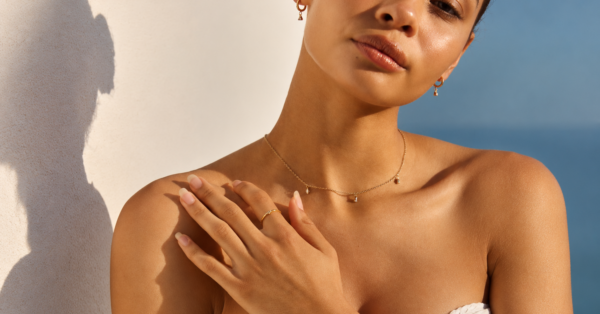
Self-tanners, tanning drops, body makeup, and bronzers: a guide to choosing them and achieving an even tone without sun exposure.
Legs reappear, décolletage becomes visible, and that pale winter hue starts catching the eye in the mirror. But the answer no longer necessarily lies in sunbathing: color can also be built up with cosmetic products.
Self-tanners, facial drops, body makeup, and bronzers allow for different results. Some develop the color gradually; others offer an immediate effect. The key is to understand how each one works and how to apply it correctly.
How Self-Tanners Work
The color of most self-tanners is produced by DHA, a compound that reacts with the dead cells in the outermost layer of the skin. The tone appears gradually in the hours after application and typically lasts for several days.
The formulas have evolved from those dense products that could leave streaks or an obvious orange tint. Today there are mousses, lotions, sprays, serums, and drops that allow you to calibrate the intensity.
“Users prefer to build color gradually, adjust the intensity and minimize mistakes,” explains Sabrina S. Alberti, a specialist in cosmetic marketing and market research.
How to Apply Self-Tanner Without Streaks
Preparation starts before opening the product. The skin should be clean, dry, and exfoliated, especially in areas that tend to accumulate more color.
Apply it in sections and distribute the product with circular motions. In elbows, knees, and ankles, it’s advisable to use less product because these areas can absorb more and appear darker. It’s also important to wash your hands after treating each section to prevent staining your palms.
Once finished, you must respect the drying time indicated on the packaging. The American Academy of Dermatology recommends waiting at least ten minutes before getting dressed and choosing loose-fitting clothing for the following hours.
Tanning Drops, Body Makeup, and Bronzers: What Each Brings
The tanning drops allow you to regulate the tone by the amount used. “More drops, more color. Fewer drops, a subtle effect,” notes Alberti. Serum-type formats also meet the search for lightweight products that can be integrated into the facial routine.
Body makeup, on the other hand, offers immediate color. It is applied to clean, exfoliated, dry, and oil-free skin. It can be applied to legs, arms, and décolletage, and it should dry well before coming into contact with clothing.
Bronzers provide a superficial effect and can be used to highlight specific areas. The sparkling versions add luminosity to shoulders, décolletage, arms, and legs.
Self-Tanner Does Not Replace Sunscreen
Bronzed-looking skin is not protected against ultraviolet radiation. Unless the product includes sunscreen filters and declares a sun protection factor on its label, self-tanner does not prevent sunburn.
Therefore, sunscreen remains indispensable every day. The recommendation from the American Academy of Dermatology is to use a broad-spectrum, water-resistant sunscreen with an SPF of 30 or higher.
In the case of spray self-tanners, the FDA also advises avoiding inhalation and contact with eyes, lips, nose, and other mucous membranes. It is always important to follow the specific instructions on the packaging.
The Key Is to Build Color Gradually
Starting with a small amount allows you to observe how your skin tone responds before repeating the application. Mistakes aren’t necessarily visible right away: as the color develops over the following hours, an uneven distribution can become evident later.
The new generation of self-tanners offers a progressive and customizable result. It’s no longer about achieving a deep tan in a single session, but about adding color with greater control and without resorting to sun exposure.