
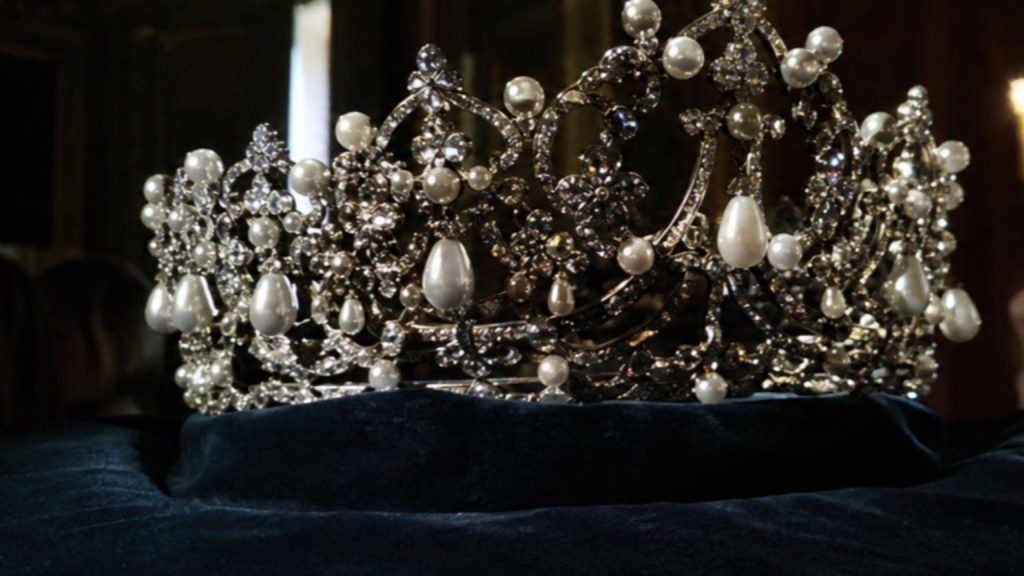
A single jeweled silhouette has threaded its way through a century of royal portraits, evening banquets, and diplomatic flashbulbs. Its pearls sway, its diamonds wink, and its story is written across three formidable women. In every era, this diadem has felt both ancient and startlingly new, a glittering echo with a pulse.
The Making of a Modern Classic
In 1913, Queen Mary commissioned a fresh interpretation of a family treasure, asking the jeweler Garrard to craft a tiara that nodded to a beloved ancestor. The model was the famed Cambridge Lover’s Knot, once worn by the Duchess of Cambridge, and reborn in a sleeker, more architectural key.
Queen Mary’s version fused tradition with audacity, harvesting pearls and diamonds from the royal trove to shape arches, bows, and suspended drops. The result felt “timeless yet alive,” a piece that could command a tiara room and whisper of lineage in the same breath.
A Bow to Romance, a Frame for Power
The diadem’s hallmark is the series of diamond-set arches crowned by delicate bow motifs—“lover’s knots” that lace romance into rigid geometry. Between the arches hang pear-shaped pearls, capable of movement that adds a subtle theater to every turn of the head.
People often say the piece is heavy, and that the pearls can “chime” against the diamonds when the wearer moves. That tiny sound is like the tiara’s signature—a private music of state, glamour, and duty, carried just behind the ear.
Diana’s Dazzling Era
Decades after Queen Mary, the tiara returned to the glare of global attention on the head of the Princess of Wales. Loaned from the monarch’s collection after her marriage, it quickly became one of her most recognizable evening choices.
Diana’s affinity for the piece was instantly photogenic, the swaying pearls softening strong lines of velvet, satin, and sequins. “It felt both royal and romantic,” her public seemed to say without words, the image reproduced on magazine covers and mantelpiece calendars alike.
Not every night called for such weight, and she sometimes reached for lighter alternatives. But when statecraft required a visual crescendo, the lover’s knots answered with grace—and a hint of steel.
Catherine’s Confident Refrain
In the 21st century, the diadem found a new custodian in Catherine, the Princess of Wales, who began wearing it in the mid-2010s. Her first public outing with the piece signaled a cool, confident modernity: sleek gowns, unfussy lines, and diamonds doing the heavy lifting.
She repeats it with the assurance of someone who knows continuity is the point. Set against column dresses and streamlined tailoring, the tiara reads as both heritage and headline, a throughline from great-grandmother-in-law to present day.
Fans notice the small tweaks—hair parted just so, earring choices echoing the pearls—and the way the knots catch camera light. Each appearance feels like a quiet conversation with history, conducted in diamonds and poise.
Why This One Endures
Plenty of royal diadems are storied—the Lotus Flower is light and lyrical, the Vladimir endlessly versatile, the Girls of Great Britain and Ireland boldly iconic. Yet few balance sentiment, silhouette, and symbolism so effortlessly as this bow-and-pearled marvel.
Its secret is the tension between softness and structure. The romantic knots sell a human story; the crisp architecture sells sovereignty. It suits portraits, processions, and pixelated phone screens, which is exactly where monarchy now lives—everywhere at once.
How to Spot It at a Glance
- Diamond arches crowned with neat “lover’s knot” bows—think graphic, not frilly, and elegantly uniform.
- Pear-shaped pearls dangling beneath each arch, adding movement and gentle drama.
- A confident, slightly high profile that frames the face like a jeweled halo.
- An overall balance of sparkle and silhouette that reads “romantic power,” never overly ornate.
The Subtle Politics of Sparkle
Every tiara appearance is also a message: loans signal trust, continuity, and the quiet mechanics of royal duty. This piece, more than most, looks like inheritance in motion—its wearer temporarily holding a torch that others have held before.
“Jewels remember,” as the old saying goes. They remember faces, flashbulbs, triumphs, and lessons, and they send those memories down the royal line.
An Heirloom with a Pulse
When Queen Mary first imagined this diadem, she built a bridge—between centuries, yes, but also between private devotion and public role. Diana carried it into a new media age, turning sentiment into widespread fascination. Catherine, in turn, wears it like a superlative adjective: the finishing word in a sentence about state, style, and steadiness.
Look closely and you’ll see more than diamonds and pearls. You’ll see rehearsal and ritual, grief and grace, and the reassuring rhythm of a story that never quite ends. In that rhythm, the lover’s knots keep time—bow by bow, drop by drop—forever royal, forever renewed.
