
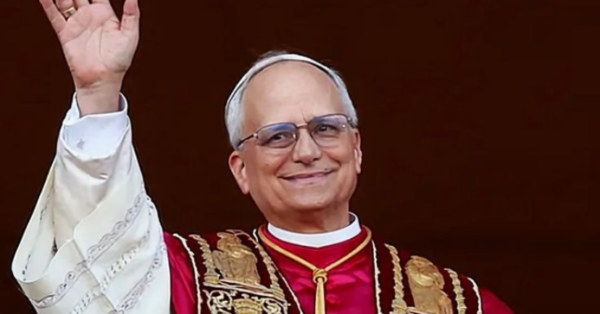
It is the third day of the Pope Leo XIV in Argentina and his schedule is still in full swing. Transfers, masses, speeches, meetings, and encounters with thousands of people follow almost without pause. Yet at 71 years old and after a recent surgical intervention, he appears active, smiling, and with a vitality that inspires admiration.
On October 13, Leo XIV underwent surgery in which the lower lobe of his right lung was removed after an early-stage adenocarcinoma was detected. The operation was successful, and according to official Vatican information, subsequent checkups confirmed a favorable progression and that he did not require any additional oncological treatment.
Before undertaking his journey through Latin America, his medical team evaluated his condition and determined that there were no contraindications to fulfilling the tour, although his schedule was adjusted to respect the necessary periods of rest.
But beyond a good recovery and the corresponding professional follow-up, there is a habit that could help explain his resilience: Leo XIV has practiced sports since youth and maintained for years a routine that combined cardiovascular and strength exercises.
The training routine that Robert Prevost never abandoned
Before becoming Pope, the then-Cardinal Robert Prevost trained at the Omega Fitness Club, a gym near the Vatican that he began attending in 2023.
There he met the Italian coach Valerio Masella, who accompanied him for almost two years without knowing that the reserved, kind, and steady man was a cardinal. He knew him simply as Robert and, from his way of dressing and behaving, he came to think he was a professor or academic.
Prevost used to attend two or three times a week. When he could, he completed sessions of about an hour, but his schedule did not always permit it. And it is precisely there that the most interesting detail of his discipline emerges: if he only had a few minutes, he did not rule out training.
“He would arrive and say: ‘Today I have 20 minutes, what do we do? Today I have half an hour, what do we do?’”, Masella recalled.
According to the trainer, the future pontiff did not look for excuses or wait for ideal conditions: “Sometimes it happens that some people do not want to exercise, that they don’t feel like it or something like that. He, on the other hand, was always highly motivated and trusted us.”
Strength, cardio, and exercises to improve posture
His plan combined aerobic work with strength and posture exercises. He alternated the treadmill, the stationary bike, and the elliptical —one of his favorite machines— with resistance machines and weight training.
Masella noted that he learned the technique correctly and had a very good physical condition for his age. He also pointed out that the program was designed specifically to his needs, his schedule, and his physical state.
“The routine is built on the basis of a consultation. We see what the person needs and create a tailor-made program,” explained the trainer.
Prevost kept up his training until the end of March 2025, a few weeks before the conclave that would elevate him to Leo XIV.
The gym was not his only link to sport. He is also a tennis enthusiast and, during the early months of his pontificate, continued playing it whenever his schedule allowed. Added to that are walks and other activities he maintained throughout his life.
The Lesson Highlighted by an Expert
Nutritionist Mariela Marín, a specialist in menopause nutrition and creator of the account @mmnutricion_, analyzed the Pope’s training and focused on a behavior that can be translated into daily life.
“He does not wait for an hour free to go to the gym. If he has 20 minutes, he trains for 20; if he has half an hour, he makes the most of that half hour,” she noted.
Marín linked this attitude to something she frequently observes in women with very demanding work and family schedules.
“Sometimes, if they don’t have an hour available to train, they simply rule out the possibility of doing it that day. And thus, many days can pass without providing a stimulus to the muscles,” she explained.
The problem isn’t always the complete lack of time, but the idea that a workout only works if it can be done for a full hour, in a gym, and under perfect conditions.
Twenty Minutes Can Also Count
The approach isn’t about training any which way or demanding more from the body than it can give. The second key Marín highlights is that the Pope trained with the guidance of a professional.
“There is planning, there is a criterion behind what he does, because when you have little time available, how you use it matters a great deal,” she stated.
A short session, but properly designed, can include exercises that mobilize different muscle groups and provide a useful stimulus. According to the nutritionist, “a 20- to 30-minute session well planned can be a stimulus to improve strength and also contribute to the improvement of body composition.”
This does not mean that twenty minutes always replace a longer routine nor that everyone should train the same way. Age, health status, prior injuries, and activity level require individual assessment.
But it does allow dispelling a belief that often leads to inactivity: if I cannot do the perfect workout, then I do nothing.
Do Not Wait for the Ideal Moment
Leo XIV’s discipline offers a lesson that goes far beyond the gym. Often we postpone what benefits us because we wait for more time, more energy, or an organization that rarely appears.
As Mariela Marín sums up: “You will not always be able to train under ideal conditions, but that does not mean you have to stop. Sometimes making the most of the 30 minutes you have is far more useful than continuing to wait for an hour or an hour and a half that never appears.”
Perhaps the real secret isn’t finding time, but learning to use the time you actually have.
Twenty minutes of movement do not solve fatigue on their own nor replace rest, proper nutrition, or medical follow-up. But they can become a possible, sustainable and realistic decision. And often, that consistency built with small gaps is worth more than a perfect routine that we never start.
