
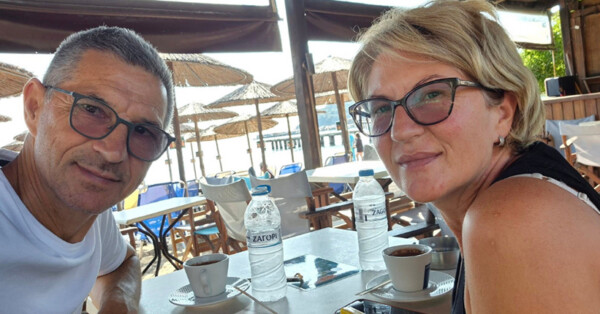
There was no time to think, to ask for help, or to gauge the danger. Svetlana Grković heard a loud detonation, turned her head, and saw that part of her husband’s body had been dragged toward the outside of the plane. Then she made a desperate decision: she clung to his legs and refused to let him go.
“I thought: ‘If we die, we die together,’” the woman recalled as she recounted the most terrifying seconds of her life. Along with other passengers, she managed to hold Ljubiša Karović, 61, until they could pull him completely back into the cabin.
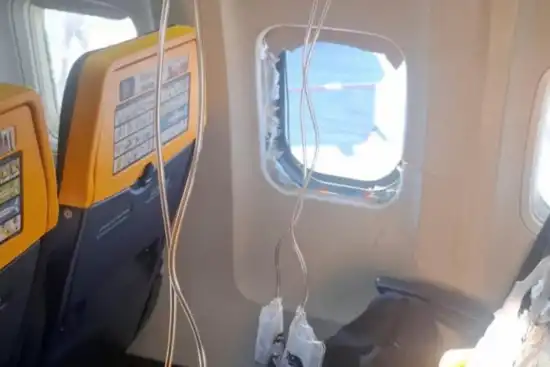
The dramatic episode occurred on Friday, July 10, on a Ryanair flight that had departed Thessaloniki, Greece, bound for Memmingen, Germany. A window pane detached shortly after takeoff, causing a sudden decompression and forcing the pilots to return to the Greek airport.
A Detonation and the Onset of Horror
Svetlana and her husband had settled in for the journey and, according to her account, they were probably dozing when a bang interrupted the cabin’s calm.
Upon turning around, she saw Ljubiša’s head and one arm outside the aircraft. In other testimonies, the woman estimated that her husband had been exposed up to his chest for nearly two minutes.
The pressure generated by the decompression was so intense that some passengers tried to place a suitcase against the gap left by the window, but the luggage was also dragged outward. At the same time, oxygen masks fell, and screams multiplied aboard the plane.
“I reacted instantly and grabbed his legs,” Svetlana said. While she held him, a young woman seated next to Ljubiša clung to his arm. The arrival of another passenger allowed several people to finally pull him back inside.
The Seat Belt That Could Have Saved His Life
Amid the chaos there was a decisive element: Ljubiša was wearing his seat belt. His wife believes that this prevented him from being completely ejected from the aircraft when the rupture occurred.
After retrieving him, Svetlana placed an oxygen mask on him while another person helped her. Her husband lost consciousness several times and had visible injuries to his face and body.
Other passengers described a scene of despair. Some believed that an emergency door had opened; others thought the plane would crash. The lack of oxygen, the loud noise, and the violent gusts of air left people unsure for several minutes whether they would reach land alive.
The Condition of the Passenger Sucked Out by the Window
Ljubiša was rushed to Thessaloniki’s AHEPA University General Hospital after the emergency landing. He remains hospitalized with serious neck injuries and damage to one arm, as well as friction burns and significant wounds to a hand.
His life is not considered in danger, although doctors are still evaluating the physical consequences of the episode. His wife said he cannot remember everything that happened and that he begins to tremble when he hears people talk about airplanes.
“For me, the important thing is that he is alive,” Svetlana said. But she also acknowledged that both of them were deeply affected: he by the injuries and the shock; she by having felt that she could lose him between her hands.
What Could Have Caused the Window to Break
Witnesses and sources linked to Greek aviation indicated that a fragment of the engine could have detached and struck the fuselage, breaking the window next to which Ljubiša was seated.
Ryanair confirmed that a window panel detached during the flight and that the aircraft returned to Thessaloniki on a single engine. However, the company declined to publicly state a cause and said it would await the results of the official investigation.
The aircraft was a Boeing 737-800 NG, operated by Malta Air, a Ryanair subsidiary. The passengers were disembarked after landing and later continued the journey on a replacement aircraft.
An International Investigation
The incident occurred as the aircraft was flying over North Macedonia, the country leading the technical investigation. The European Union Aviation Safety Agency, the United States National Transportation Safety Board, Boeing, and Greek authorities are also participating.
Additionally, a Greek prosecutor opened an investigation to determine what caused the failure, whether the aircraft’s maintenance met all requirements, and how the emergency response was handled. The aircraft remains in Greece as the investigations proceed.
“I Wasn’t Going to Let Go”
Svetlana does not know how long she clung to her husband’s legs. In an extreme situation, each second could have seemed endless.
She also does not yet know how long it will take them to recover. Ljubiša’s injuries will be visible for months, but the emotional scars could stay with them much longer.
The only thing she knew for certain when she saw her husband suspended between the cabin and the void was that she would not let him go. There was no prior reasoning or strategy. It was a desperate yet loving impulse: to cling to him even as she felt that the two of them could die.
And amid the deafening noise, fear, and the air that swept everything along, her hands managed to keep him alive.