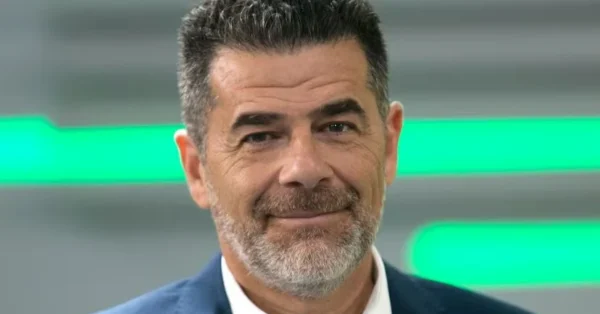
At sixty, Julián Weich is going through a phase of his life in which he says he has changed some of the ideas he held for years about love, partnership, and happiness. In an interview with Luli Fernández for Infobae, the actor and host spoke about his current relationship, the age gap with his partner, and the bond he maintains with his four children.
Far from presenting age as a constraint, Weich highlighted the connection he managed to build with his partner and summed up the bond with a blunt phrase: “I’m 18 years older, but we are equals”.
“I don’t like sleeping alone, I don’t like traveling alone, I don’t function well on my own,” he admitted when talking about his need to share life with someone.
Julián Weich and his relationship with a woman 18 years younger
Weich explained that his past experiences were marked by two divorces, and after each separation, he quickly found himself in another relationship.
“The worst thing that has happened to me in life were my two divorces. And I never had a period of emptiness or loneliness. I left a marriage and soon after I started dating again and I ask myself: ‘What am I doing back in a relationship?’” he recalled.

However, he insists that his current relationship is different. For the first time, he says he feels surprised by the kind of bond he has managed to build.
“It’s like I’m surprised by having a good connection with a partner. To call her ‘partner,’ something that never happened to me before. Now that I’m in a relationship. I’m 18 years older, but we are equals. Not in age, obviously, but there is parity,” he explained.
For the host, that generational gap does not define the bond. What matters, in his view, is how they relate to each other and the balance they have managed to build.
“I used to think I had to be happy”
During the interview, Weich also delved into a deeper reflection about the life stage he is in and stated that his concept of happiness has evolved over the years.
“I used to think I had to be happy. We all think we should be happy, and I discovered that what I really want is to be at peace, which is much better,” he said.
And he explained the difference between those states: “You don’t have to do anything to be at peace, practically. By contrast, to be happy: work, success, ratings, money.”
A perspective that, to the actor, relates to maturity and having stopped chasing certain mandates to focus on what truly brings him well-being.
His particular way of living fatherhood
Weich also spoke about his four children and what it meant to accompany them through the different stages of their growth.
“With a lot of love, with a lot of drive. I love being a dad; I don’t claim to be the best dad, nor a good dad, but I say what I like—the day-to-day work of a father: changing diapers, bathing, feeding, taking them to get vaccines,” he shared.
He even recalled with humor how time flies: “Sometimes I look at them and think: ‘Where did these four come from?’”.
Even though his children are grown, Weich maintains his enthusiasm for childhood and acknowledged that he still feels immense tenderness when sharing moments with the younger ones.
“Childhood drives me crazy. Teaching them, playing with them, getting a kid to believe anything, playing with the fantasy that… I don’t know. Oh, that drives me crazy. I see a kid and I pounce. I feel like picking him up,” he said.
He also admitted that the possibility of raising children today raises new questions for him: “When I think about what it means to raise a child today, I say: ‘Uh, it isn’t easy. It isn’t that easy.’”
Julián Weich and a lesson about death
One of the most profound moments of the talk came when he spoke about how he passes on to his children his own view of death.
“Today, at 60, I’m teaching them that I will die,” he explained. But he clarified that he does not aim to transmit distress but the opposite: “Not with the sadness that I will die or the anxiety, but with the joy with which I will die.”
In that sense, he said he learned to live with the idea of death as part of life.
“I learned to live with death, not only with life, which is something no one teaches you. They obsess you with learning to live and tell you that you must have your house, your degree, your job, your children. But no one teaches you to die,” he reflected.
And he closed with a line that sums up his current outlook: “I want to die young as late as possible.”
Thus, between his relationship, the experience of building a family, and an increasingly mindful view of the passage of time, Julián Weich showed an intimate facet marked by the search for balance. He no longer talks much about achieving an ideal happiness, but about finding something that, to him, holds far more value: living in peace.