
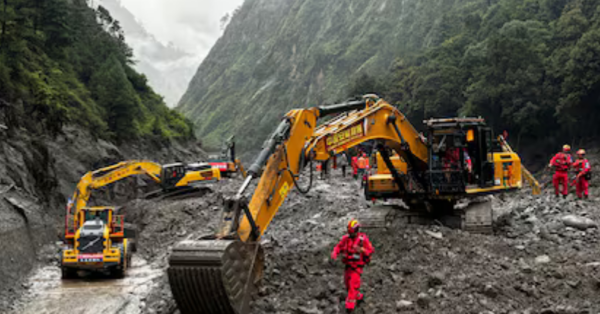
On Wednesday, August 26, a devastating flash flood struck the border area between Nepal and Tibet. The disaster caused extensive destruction across multiple points in the region and left hundreds dead and around 3,000 people missing.
In Nepal, the death toll has climbed to 669, while Tibetan authorities reported seven victims. Search and rescue operations continue, though weather conditions and damaged roads hinder access to the most affected areas.
The disaster occurred after a massive landslide of mud and rocks that fell into a river and triggered a violent flood surge. The exact cause of the release remains under investigation. Among the hypotheses being analyzed are the possible collapse of a mass of ice and rock in a high-mountain region, in addition to a seismic movement recorded shortly before the disaster.
The force of the water, mingled with mud, rocks and other sediments, swept away homes, roads, bridges and various structures. Footage recorded in the area showed entire villages buried under mud and debris.
A horrific scene of severe flooding at the Rasuwagadhi border point on the Nepal-Tibet border.
The strong currents wreaked havoc across the area, leaving 400 pilgrims and 105 Indian tourists also missing in the Nepal floods.#NepalFloods #Nepal #Rasuwa #FlashFlood #Floods pic.twitter.com/dwAX12Gj7l— Ravi Pandey🇮🇳 (@ravipandey2643) August 26, 2026
Amid the tragedy, the testimonies of those who managed to survive help gauge the scale of what occurred.
The account of a police officer who survived the surge
Rajan Khatri, a 41-year-old police officer stationed in Syabrubesi, one of the hardest-hit locations, received around 9:10 a.m. a call from a friend warning about a sudden rise in the river. Moments later the current reached the police station.
“One of my superiors and I were together when the wave arrived. I was swept away, but he wasn’t as lucky and was buried or dragged away,” Khatri recounted from a hospital bed in Kathmandu.
Şimdiye kadar Nepal’deki çığ felaketi hakkında gördüğüm en korkunç video pic.twitter.com/7AzKu03SQT
— orhun (@orhnrck) August 29, 2026
The officer also described the scale of the current and the speed with which it swept through the area. “I cannot describe the magnitude of the waves. They swallowed buildings several stories tall in a matter of seconds.”
And he added: “It wasn’t just water. It was a mix of rocks, sand and thick mud.” The police officer remained missing for hours and was finally located the next day, as the search for his colleagues continued.
The testimony of a 17-year-old girl
Several kilometers away, another account offers insight into how the tragedy surprised those in their homes. Smriti Ojha, 17, was getting ready to go to school in Trishuli, in the Nuwakot district, when she felt the ground tremble.
At first she thought it was an earthquake. The sensation felt especially familiar because in 2015 an earthquake had destroyed her family’s home.
The teenager ran out of the rented house where she lived with friends. However, just as she had managed to escape, she saw enormous waves of water approaching.
“Everyone in the house got out before it was too late, but we couldn’t save anything”, she recounted from a hospital bed.
Ojha sustained an injury to her right foot and required medical care. Her closest family, living about eight kilometers from the devastated area, managed to stay safe. However, four other relatives remain missing.
The young woman also described the emotional impact of watching everything she knew disappear before her eyes. “It was terrifying. I can’t believe everything disappeared before my eyes,” she said.
A tragedy that keeps thousands of families on edge
The accounts of Khatri and Ojha join the stories of hundreds of survivors who were rescued from the most affected zones.
The flood’s magnitude was such that the current carried away homes, vehicles, bridges, and other structures. In some areas, emergency teams had to push through large amounts of mud and debris to try to locate people who remain missing.
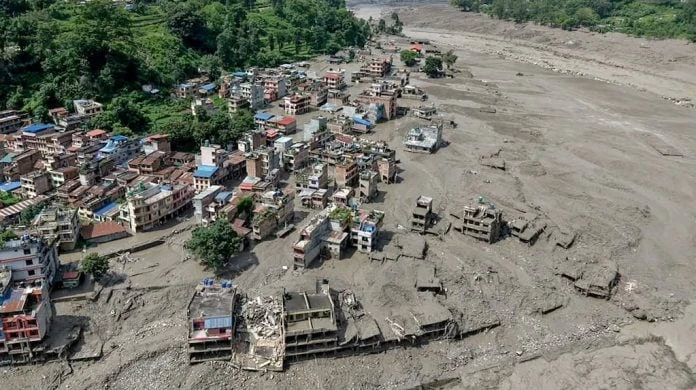
The emergency also left a heavy toll in terms of infrastructure destruction and isolated communities. The region’s geographic conditions, coupled with the damage caused by the water and mud, complicate search and rescue operations.
For those who managed to survive, a return to normal life still feels distant. Many lost their homes and belongings while awaiting news about family, friends and neighbors.
In the midst of the uncertainty, every rescue represents a new beacon of hope for the families still waiting for answers.