
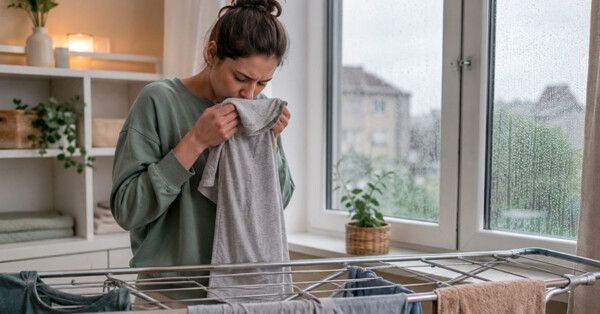
Washing clothes when it rains for several days in a row can become a frustrating task. Garments take hours — and sometimes more than a day — to dry, towels end up heavy, and when it finally seems ready to store, that unmistakable musty smell appears.
The problem returns to dominate this week: for this Wednesday, August 5, brief showers are expected in the city of Buenos Aires, while Thursday carries a yellow rain-and-thunderstorm warning, according to information from the National Weather Service.
But why can clothes smell bad even after being washed? The cause is usually not the rain itself, but the time the fibers stay wet. When drying is too slow, moisture, detergent residues, and lack of air circulation promote the appearance of unpleasant odors.
The solution is not to fill clothes with fabric softener or perfume, but to review the entire process: from the number of garments we put in the washing machine to the way we hang them.
1. Do not fill the washing machine to the limit
During humid days it is advisable to run slightly smaller loads. When the drum is too full, garments don’t move properly, soap may not rinse completely, and spinning is less effective.
In addition, a compact load comes out of the washer with more water retained and takes much longer to dry.
The recommendation is to leave enough space so that the clothes can move during the cycle. For thick garments —such as towels, sweatshirts, jeans or bedding— it is preferable to run separate washes.
2. Don’t use too much detergent
One of the most common mistakes is thinking that adding more soap will make the clothes cleaner and more fragrant. In reality, excess product can remain adhered to the fibers, especially if the washer is heavily loaded or the rinse cycle is short.
Those residues retain moisture and can end up producing a heavy or sour aroma.
The Energy Secretariat recommends using the smallest amount of soap indicated by the manufacturer, since exceeding it also forces the washer to work harder to remove it.
It is also advisable to avoid an excess of fabric softener, especially in towels: it can form a film on the fibers, reduce their absorbency, and hinder drying.
3. Add an extra spin cycle
On days with high humidity, spinning can become your best ally. When the wash cycle ends, you can program an extra spin to remove as much water as possible before hanging.
This step is especially useful for:
- Towels.
- Sheets.
- Jeans.
- Sweatshirts.
- Thick cotton garments.
- Sportswear.
Before doing it, always check the garment labels, as some fabrics do not tolerate intense centrifuging.
4. Take the clothes out as soon as the washing ends
Leaving wet clothes inside the drum, even for a few hours, can cause a musty odor to develop.
The interior of the washing machine retains heat and moisture, two conditions that favor the buildup of bad odors. Therefore, ideally remove the garments as soon as the program ends and hang them immediately.
If the clothes stayed inside all night and already have an odor, it is not enough to hang them or perfume them: it is advisable to run a short wash again.
5. Shake and separate each garment well
Before hanging, vigorously shake each garment. This simple gesture helps to separate the fibers, eliminates deep creases, and allows air to circulate more freely.
When hanging, avoid placing one garment right next to another. It is also important not to fold them over the line, especially for pants, towels, or sweatshirts.
T-shirts can be hung from the bottom, and pants from the waist, with the legs left open. Shirts and blouses dry better on hangers, provided there is enough space between them.
6. Create a breeze inside the house
Opening a window is not always enough. When outdoor humidity is high, the air can still come in laden and drying remains slow.
To speed up the process you can place the clothesline in a well-ventilated room and use:
- A fan to move the air around the garments.
- The dehumidification mode of the air conditioner.
- A dehumidifier.
- An exhaust vent, provided the room is safe and has air exchange.
The fan does not need to point directly at a single garment: the important thing is to generate a steady circulation throughout the room.
Also, it is not advisable to hang too much clothing in bedrooms or closed spaces, because all the water that evaporates from the garments stays in the air and can increase condensation on walls, glass, and furniture.
7. Do not rest clothes on stoves or dry them in the oven
Placing socks, towels, or underwear directly on a stove may seem like a quick fix, but it poses a fire risk and can also damage fibers.
Nor should you use the oven to dry clothes. If heating is used, the drying rack should be at a safe distance and never block the heat outlet.
The safest approach is to combine a comfortable room temperature with air movement. Heat alone in a closed environment can cause the water to evaporate from the clothes but remain trapped inside the house.
8. What to do when the clothes already smell of damp
When the odor is already entrenched, masking it with textile perfume does not solve the problem. Often it disappears while the garment is drying, but returns as soon as it contacts the body, bathroom steam, or a new humid day.
In that case:
- Wash the garment again without overloading the drum.
- Use the correct amount of soap.
- Choose a program with a good rinse.
- If the label allows, use an oxygen-based bleach or a product designed to remove odors.
- Add an extra spin.
- Make sure the garment is completely dry before storing it.
For delicate fabrics, wool, silk, embroidered garments, or jackets, it is best to strictly follow the label or take them to a dry cleaner.
Attention with home remedies
White vinegar is commonly used to neutralize odors, but not all washing machine manufacturers recommend its frequent use, as over time it could affect some components and seals. Before incorporating it, it is wise to consult the appliance manual.
In addition, never mix vinegar with bleach. Bleach should likewise not be combined with ammonia, disinfectants, or other cleaning products, because the mixture can release toxic gases.
9. Clean the washing machine: the odor may come from the machine
If clothes come out smelling as soon as the wash finishes, the problem may be inside the appliance.
Moisture and detergent residues can accumulate in:
- The door seal.
- The soap and softener drawer.
- The filter.
- The drum.
- The internal channels.
After each wash, it is advisable to dry the seal with a cloth and leave the door slightly ajar to facilitate air circulation. Manufacturers also recommend periodically cleaning the product compartment and using the drum-cleaning cycle, always following the manual’s instructions.
The last step: do not store anything that is barely damp
A garment may feel dry on the outside while still holding moisture in seams, pockets, cuffs, elastic bands, or waists.
Before folding, pay special attention to:
- Collars and cuffs.
- Waists on jeans and pants.
- Hoodies.
- Pockets.
- Seams of towels.
- Elastics of underwear.
- Lining of jackets.
Storing clothes too early can transfer the odor to the entire wardrobe. On very humid days, it is preferable to leave them a few more hours spread out, iron them if the fabric allows, or finish drying near a draft.
Regularly ventilate closets, avoid stacking garments too tightly, and use indoor-safe moisture absorbers.
Checklist to prevent clothes from smelling musty
- Do smaller loads.
- Use the correct amount of detergent.
- Add an extra spin.
- Take clothes out immediately.
- Hang garments separately.
- Generate air circulation.
- Do not store anything that retains moisture.
- Clean the washing machine periodically.
- Re-wash clothes if they already smell.
- Never mix bleach with other cleaners.