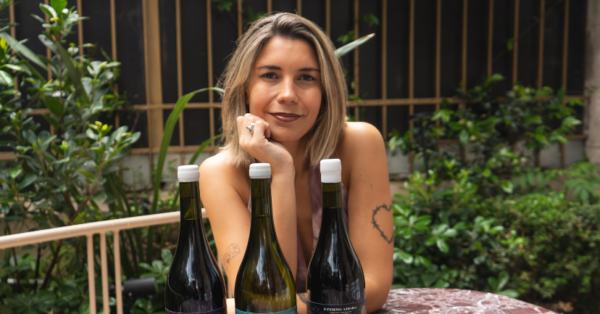
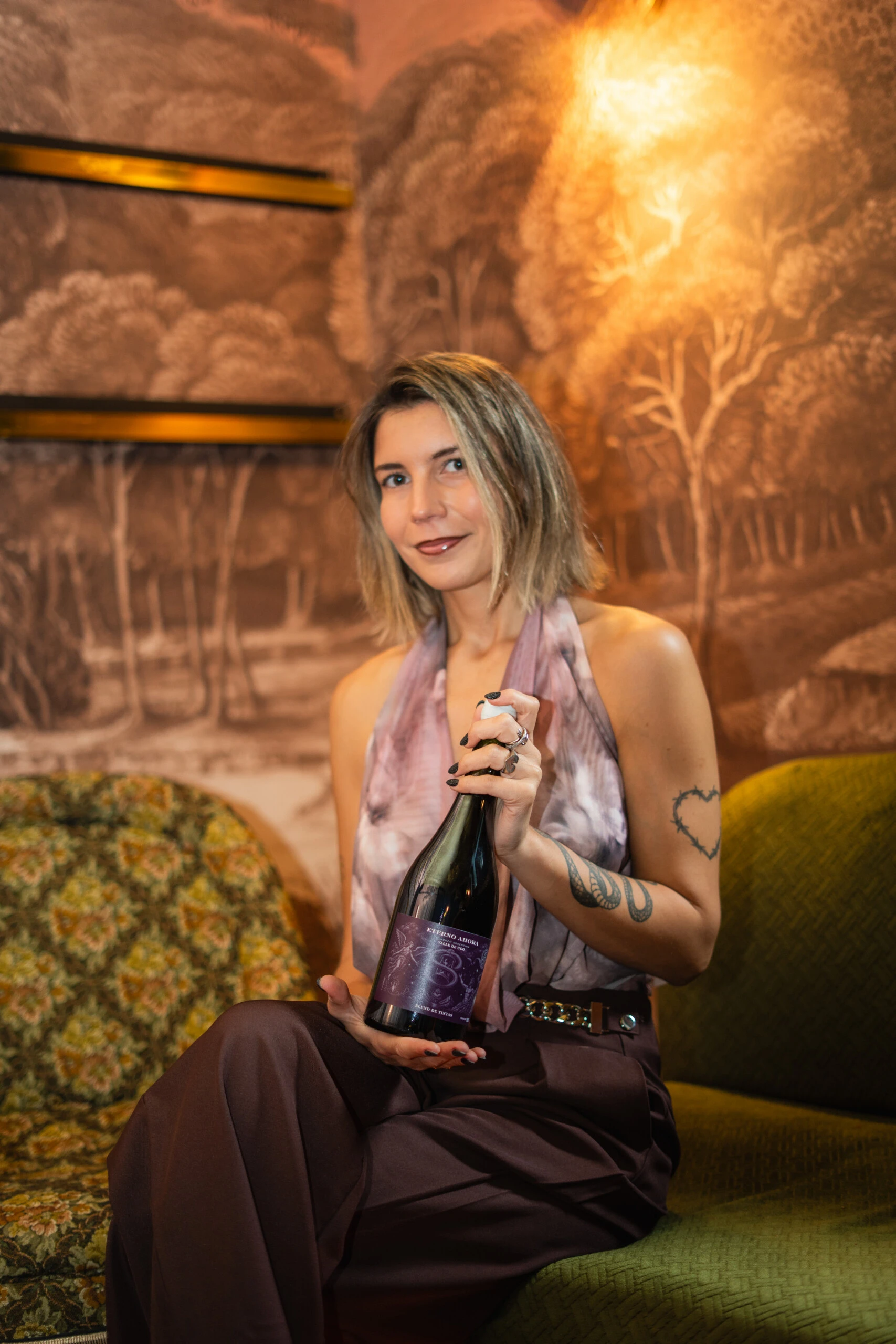
For years, Sofía Bernatet saved money with a fairly common goal: to buy a house. She had grown up believing that stability began with owning space of her own, and she followed that plan until a question, in the middle of a vineyard in the Uco Valley, altered the course: “What if I make my own wine?”
It wasn’t a sudden impulse. Every trip to Mendoza left something behind—a conversation, a landscape, a new experience. When that idea finally took shape, Sofía had more than a decade of corporate work behind her and had already found in sommelier craft a personal way to communicate.
Her way of talking about wine is far from technical jargon: she prefers to tell who worked the land, what story lies behind a bottle, and why that journey is part of what reaches the glass.
With the savings she had set aside for her house and without partners or investors, she allocated 35 million pesos to create her first line. There was fear, trials, a change of winemaker, and many decisions that didn’t appear in any textbook. From that process emerged her brand, but also a new way of thinking about success, work, and inherited mandates.
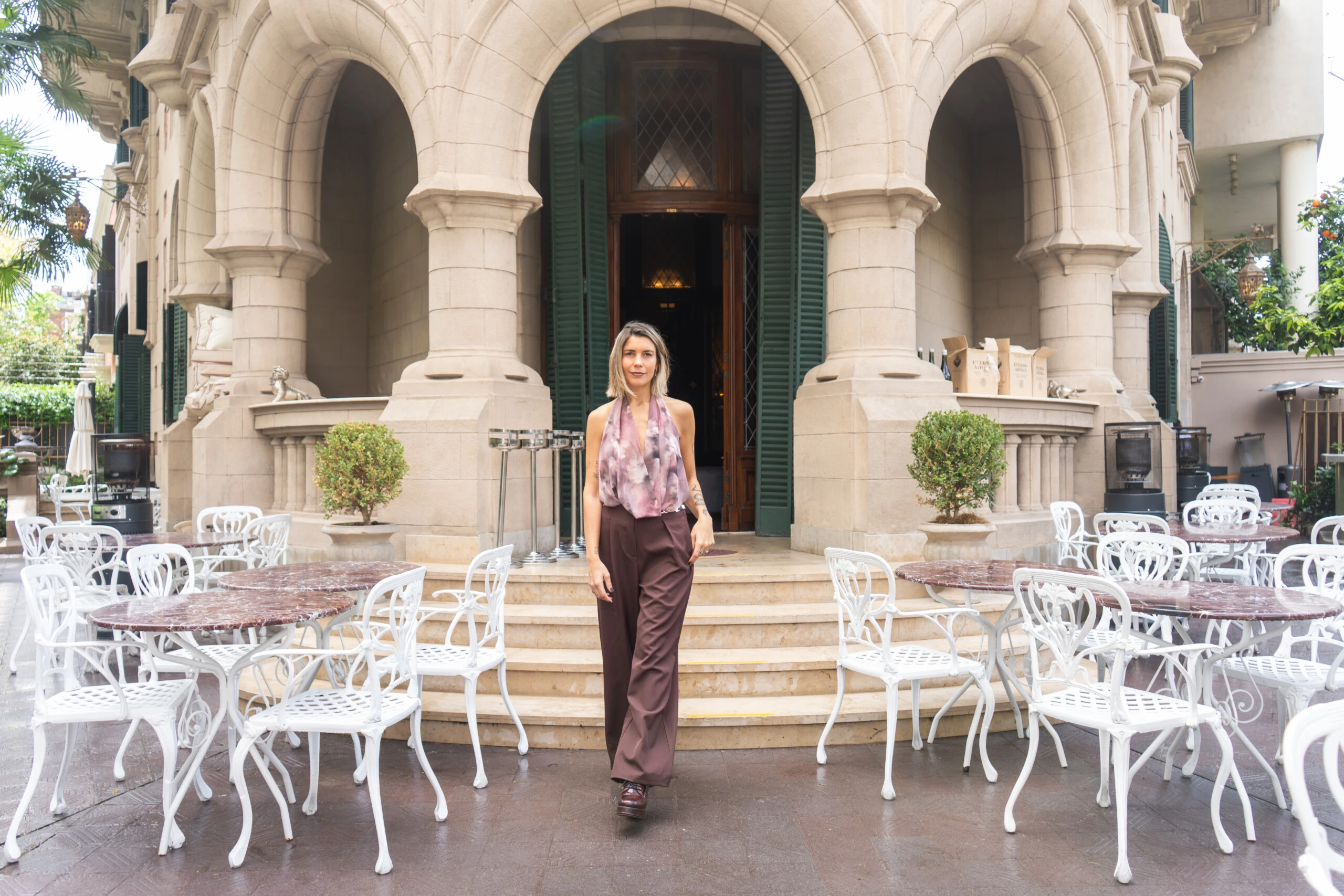
The story behind every bottle
—If you had to explain to someone what it means to be a sommelier, beyond formal tasting or a restaurant’s wine list, where do you find the true magic of this profession?
—In being able to convey to ordinary people all the story behind each bottle. Sometimes we focus so much on the final product that we don’t value everything that came before: the process, the dedication, and the families who cultivate the land so that that liquid reaches the glass.
For me, the magic is there: in being the bridge between that story and the person who is drinking the wine without knowing it.
—During your trips to Mendoza, was there a particular glass or landscape that made you think you no longer wanted to simply recommend wines, but to craft your own?
—It wasn’t a single glass or a single landscape, but a accumulation. Every trip left me with something. Until, on one of those journeys, standing in the middle of a vineyard, the thought appeared: “What if I make my own wine?”
I think that was the turning point: standing in the middle of the Uco Valley, connecting with the land and the vineyard.
The day the dream of a house gave way to a personal project
—Buying a house typically represents stability. How did it feel to decide to pour all your savings into a viticultural project?
—I think this is something that’s been happening a lot in my generation. We were brought up with the idea that stability starts with saving for a house. That was the aspiration.
Although it was hard at first, I chose to break with that pattern: to bet on my own thing instead of following a mold society takes for granted. There’s no better investment than betting on a passion.
Saying it was a decision made overnight would be a lie. There were many thoughts, scenarios, and fears. The fear of failure was always there.
But I was surprised by how people close to me reacted. Everyone I told about this “crazy idea” said the same thing: “You have to do it, it’s your passion and you have everything you need to make it work.” That support was fundamental. The backing of people who love you and know what drives you is worth more than you think when you’re in doubt.
—How did your family and friends react when you told them you were going to swap square meters for barrels and vineyards?
—From the very start they supported me and urged me to go for it. But it wasn’t only moral support: they became active participants in the project.
When I had to choose between label designs, I called on them. When the first finished samples arrived, they were the first to try them. They became my decision-making committee.
At the end of the day, it’s a project that has to please me, but also the public. That is fundamental for it to sell. Having honest people close who tell you what they really think, without filters, is a luxury not every entrepreneur has.
My dad, a fan of Pappo, was my biggest supporter. That’s why each cork carries engraved a line from the musician: “In an obsolete world there is no time, no age, no end.” It’s an intimate tribute, hidden inside the bottle.
What theory doesn’t teach about producing a wine
—Creating a wine from scratch involves dealing with harvests, timelines, and production decisions. What challenges did you encounter?
—I knew I wanted to launch in 2026, so timing wasn’t negotiable. That meant working with base wines from other vintages and starting to play with barrel aging and blend percentages until I reached the styles I wanted.
It wasn’t a linear process. It was trial, adjustment, and trial again.
Since it was the first vintage and also a test, I didn’t make harvest or vineyard decisions; that remained with the winemaker. My challenges were more about production and commercial aspects: quantities, labels, cost optimization, and defining styles. These are issues that seem simple in theory but in practice involve many variables.
—What was the toughest moment?
—The Cabernet Franc was the toughest because it is the wine that represents me the most. In the middle of the process I had to change winemakers, as with Berni we weren’t achieving the style I wanted.
Finding someone who could finish it and sustain the original vision without losing it along the way was probably the most demanding moment of the entire project. I eventually completed that work with Roberto Romano of Barroco Wines, who taught me the most.
The most important thing was not giving up.
The personal traits that remain inside the bottles
—It’s often said that a wine speaks of its maker. Which aspects of your personality are reflected in this first line?
—I think these wines bear my personality one hundred percent. I am hyperactive, complex, yet authentic. I make firm decisions and don’t let myself be swayed by others’ opinions. I am deeply convinced by everything I do.
That shows in the brand: I didn’t do what the market expected, but what I needed to do and what I wanted to convey to consumers.
I am also very demanding of myself and of what I produce. Every detail of the label, every styling choice, and every word on the back label passed through that filter. Nothing is there by accident.
Moreover, my way of connecting remains imprinted. I don’t have many ties, but those I have are genuine. I love sharing my learnings and my achievements with my close circle, and that’s what I want this wine to do. It’s not for any moment or any person: it’s for the ties that are worth it.
—How does that idea translate into the three wines?
—There is a red blend designed for sharing with others; a white blend for moments for two; and a Cabernet Franc for being with yourself after a day full of things.
An identity built around time
—What universe did you aim to convey through the name and the labels?
—The claim is “Made for present souls,” and it isn’t accidental. I want anyone opening a bottle of Eternal Now to already be living a good moment, and for the wine to make that moment last forever.
It’s not a wine that creates the moment; it’s a catalyst: it elevates it, deepens it, and makes you more present in what’s happening.
That is reflected in every element. The serpent—the Ouroboros—represents the endless cycle, the thing that always returns. The broken clock is the time you choose to stop. Dionysus, the god of wine and ecstasy, invites celebration and enjoyment.
The archangel is the guide between the earthly and the sacred, and beneath it all appears the burning heart: the passion from which the project was born. No symbol is placed merely for aesthetics; each one tells a part of the story.
Finding a place of her own within the industry
—The world of wine has historically been dominated by men and traditional families. How did you build your space as a young woman and producer?
—While the wine world carries that history, my experience was different. It is a surprisingly collaborative environment. Unlike other sectors, I found a real openness to new proposals and a genuine willingness to support projects arriving from different places.
With every person I spoke to, doors opened, proposals arose, and support appeared for what I needed.
I think the place I came from also helped. I was seen as a “different” sommelier, someone who always spoke of wine with emotion rather than jargon. I didn’t enter to conquer an already-held territory: I came to find my people within the wine world, and I found them.
Intuition, learning, and what lies ahead
—Looking back, what was the greatest lesson that trusting your intuition gave you?
—That it was right, and that you shouldn’t be afraid to dive in headfirst.
What surprises me most isn’t the wine’s outcome itself, but everything the process is giving me: maturity and lessons I wouldn’t have gained otherwise.
I’m convinced that, in the future, this project will allow me to buy that house. Or maybe not—who knows. Perhaps that won’t be the mandate I want to cling to anymore. Maybe I’ll buy a vineyard.
I’m already thinking about what comes next. I want the project to grow beyond Mendoza: to explore Salta, Patagonia, and other regions of Argentina. I’m already in talks with winemakers to start doing that in the coming years.
Intuition has brought me here. I have no reason to stop listening to it.
—With what dish, in what place, and with whom do you imagine toasting to celebrate that the wine is finally on the streets?
—With a great barbecue. No ceremony or perfect pairing: the most traditional and honest expression that exists.
Surrounded by my family, who were present in every decision, every doubt, and every achievement. Those same people who tasted the first samples, chose among label designs, and pushed me when fear appeared.
And, of course, in Mendoza, looking toward the mountains, with the silence between the peaks in the background. No noise or rush. Just that moment that, like all moments that matter, deserves to last forever.
Acknowledgments: Mariana Rolandi Perandones