“Oh, what a sorrowful day in Granada, when even the stones seemed to cry,” as Federico García Lorca once lamented.
This is nothing new for the people of Granada, for from time to time the movements of the Eurasian and African tectonic plates shake the area, turning the region into a zone of heightened danger. In recent years, earthquakes of varying intensity have been recorded—April 1956; July 1979; and in 2021, when several tremors occurred between January and February.
But this August 2026, saturated with fires and scorching heat, added a fresh datum to the topographic reading. It invites us to read the topography of metaphor.
Coinciding with the 90th anniversary of the execution of the Granada-born poet Federico García Lorca, this August 18 echoed the earth in that other August 18 of 1936.
Defender of freedom In his theatrical work Mariana Pineda. Romance popular in three estampas (scenes), written in 1925, the author gathered a lyric from oral tradition that recalled the heroine executed in the nineteenth century.
Lorca integrated and stylized couplets from popular folklore about Mariana Pineda’s death into the chorus of children who recite in a symmetric way: “Oh, what a sorrowful day in Granada, that made the stones cry, to see Marianita die on the scaffold for not declaring!”
The play narrates the brave life of a woman who challenged the dictates of her era, and her death: Mariana Pineda is executed in Granada for refusing to betray the patriots, after being discovered embroidering a banner with the slogan of the cause for freedom.
Inspired by this historical figure, the poet did not know that years later his own execution would echo his heroine’s death. The events of the Spanish Civil War gathered pace, and Víznar, a secluded ravine in Granada, became a mass grave for many revolutionaries.
Federico was 38 years old and had already written landmark works such as Romancero Gitano, The House of Bernarda Alba, Doña Rosita the Spinster. He had travelled to New York, to Cuba, to Montevideo and had chosen Buenos Aires as his residence for six months before returning to Spain… and his sorrowful end.
Anniversary Syndrome: the Earth Cracks and Remembers Other Tremors
There are moments when dates carry a count that escapes the official calendar because they inhabit the realm of the collective unconscious. They layer information, return to sustain the shared memory of culture, families, and individuals.
Anne Ancelin Schützenberger, in her book “Ay, mis ancestros!” revisits a key concept for psychogenealogy: the anniversary syndrome. She writes: “We often observe that a birth occurs to remind us of an important event, sad or joyful. Many babies are born by coincidence, as if to mark the grandmother’s anniversary (birth or death) or to enact a reminder of the bond between the mother and her mother (or father), as if there is a complicity between the unconscious of both…
It is also common to decipher the sense of an premature or delayed birth in relation to an important family member – dead or alive – within the family.”
Repeating events. Always with a “family air,” different each time, yet recognizable alongside other past events shared. They plant milestones, signposts, reminders. Why?
Because the family unconscious guards memory, legacy, what was learned and what was endured. Something already lived reappears. The scene may change or new details may emerge, but the tone endures: tragedy, progress, achievement, distance, losses, collective mourning… They are the anniversaries belonging to the individual and their surroundings: the community, the shared history.
The term derives from the notion developed by psychologist and psychiatrist Josephine R. Hilgard, the anniversary reaction. In her hospital work, she concluded that it was statistically significant that psychotic patients manifested the first outbreak at the same age at which one of their parents had died, or echoed a traumatic situation within the family circle.
These repetitions allow awareness to emerge, to revisit events that press against forgetting, that have been left unresolved, and that continue to bear traumatic repercussions, in order to give them a new opportunity to reinterpret what happened.
Today, in transgenerational terms, we speak of the anniversary syndrome as the reappearance of certain events linked to impactful happenings within the family system due to their emotional charge and the conflicted memory that recurs cyclically, like a kind of calendar mark.
It manifests as diffuse states of sadness or anxiety without a clear cause at the arrival of a specific date, physical pains or discomfort that reiterate past symptoms, accidents or sudden ruptures of bonds, and any expression of a lingering grief that has not been resolved.
Psychogenealogy studies these turns of the unconscious around repeated situations that go unnoticed or are read as “coincidences or chance events” (specific dates, recurrent stories, crises within a genealogical tree, as well as the same ages at marriages or divorces of ancestors, tragic deaths, exiles, etc.).
The aim is to raise awareness about possible repetitions, since clearing this information from the family system can release the burden.
A clinical example: a patient tells me of a dream in which she argued with another person about how to say a word: “This is already resolved,” she said, and the other replied: “It is said resolved.” She argued that the lapsed form sounded more complete. The tension between the correct wording and the way it was spoken incorrectly emerged in the two terms. It was interesting to break down the two words, to observe that two opposed ideas—“forgetting” and “letting go”—appeared in a coded conflict. Indeed, Freud alerted us to the power of remembering in order to forget, and that errors are not mere chance or carelessness, but a conflict between two different intents. A memory elaborated reduces the compulsion to repeat and allows transforming suffering into knowledge.
The process of “working-through” (repeatedly recalling and revising the memory in a therapeutic setting) helps ease the automatic reaction of repetition. Hence Freud’s maxim: “Remembering is the best way to forget.” In Psychopathology of Everyday Life (1901), the father of psychoanalysis invites us to observe, with a sideways glance, phenomena that other sciences consider insignificant.
The lapsus is the moment when another truth emerges, one that the person knows without knowing that they know it. And later, in his 1914 work Remembering, Repeating and Reworking, Sigmund Freud offers this central idea: patients in psychoanalysis cannot always recall forgotten or repressed events from their past, but they repeat them through symptoms or by enacting them in the present.
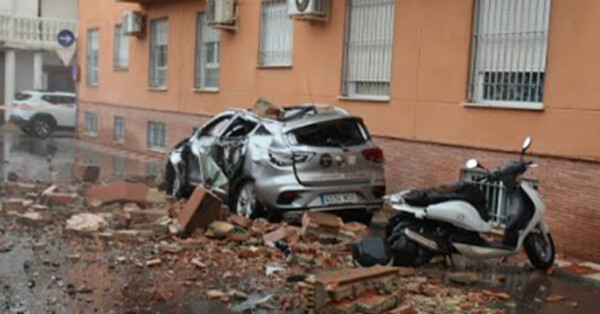
Just as with the individual, these unconscious marks occur in cultural spaces, in history and in the forces of nature, such as the earthquakes in southern Spain in mid-August. Granada trembled again, and while geologists and historians, everyday neighbors, and scientists from the National Geographic Institute speculate, analyze, and take precautions, psychogenealogy opens a different dimension for us. The great human family preserves a memory that is reaffirmed—sometimes—by Mother Nature’s almanacs. And these events remind us that it is necessary to care for the planet, sustain memory, and observe that violence, rupture, and social collapse set a pace and promise to return unless we are able to alter the modes of coexistence, the respect for difference, the value of art, and the freedom of expression.
Seismologists explain that earthquakes result from a release of energy, because the earth’s crust accumulates tension until a point at which the material can no longer bear it and a rupture occurs.
Tectonic tensions, social tensions, poetic tensions… And their various modes of expression. This time, the earth cracked in the very place where, 90 years ago, one of the most important writers of the 20th century was murdered.
Coincidence between the earth’s roar and Federico’s death? I prefer to call it an existential metaphor: repetitions return to invite us to think, to review, to analyze, to strip away the geological layers from the traumatic event. To prevent the debris of forgetting from swallowing the heritage time has bequeathed us.
Source: Diana Paris is a Doctor of Letters, a psychoanalyst, educator, and writer. Her books published by Del Nuevo Extremo deepen transgenerational studies and the relationship between psychoanalysis and literature.