
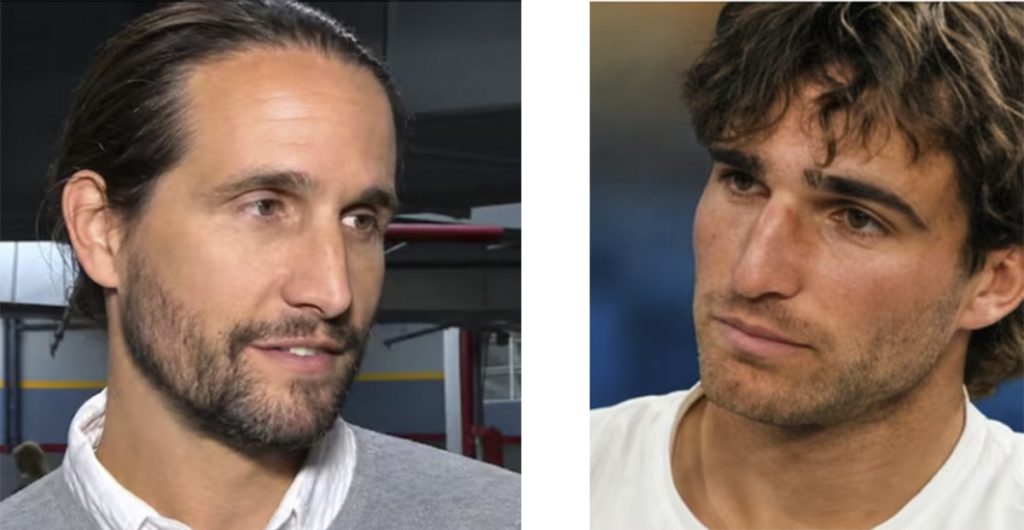
Following Valentín Yankelevich’s accusation against his father, Darío Giordano, the businessman’s public response stirred further repercussions. In his statement, Giordano rejected the allegations and spoke of the family conflict.
Drawing from his own words, the psychologist Florencia Rodríguez analyzed which discursive mechanisms she identifies in the text, how she interprets the portrayal of Franco and Valentín’s father, and how, in her reading, his son’s emotions are being invalidated.
In this column written exclusively for Para Ti, the professional examines the statement phrase by phrase and reflects on domestic violence and its consequences on the mental health of children and adolescents.
Analysis of Darío Giordano’s Statement: “A Typical Manipulation Strategy in This Type of Profile“
- By Florencia Rodriguez, Licensed in Psychology, License No. 47,400.
Physical and psychological violence have devastating effects on the mental health of children and adolescents. In Argentina, six out of ten children under the age of five suffer abuse from their parents.
This week, Valentín Yankelevich, son of Romina Yan and Darío Giordano, alleged enduring episodes of physical violence by his father. He stated that the violence became evident after the sudden death of his mother and that his brother Franco was also a victim of these acts.
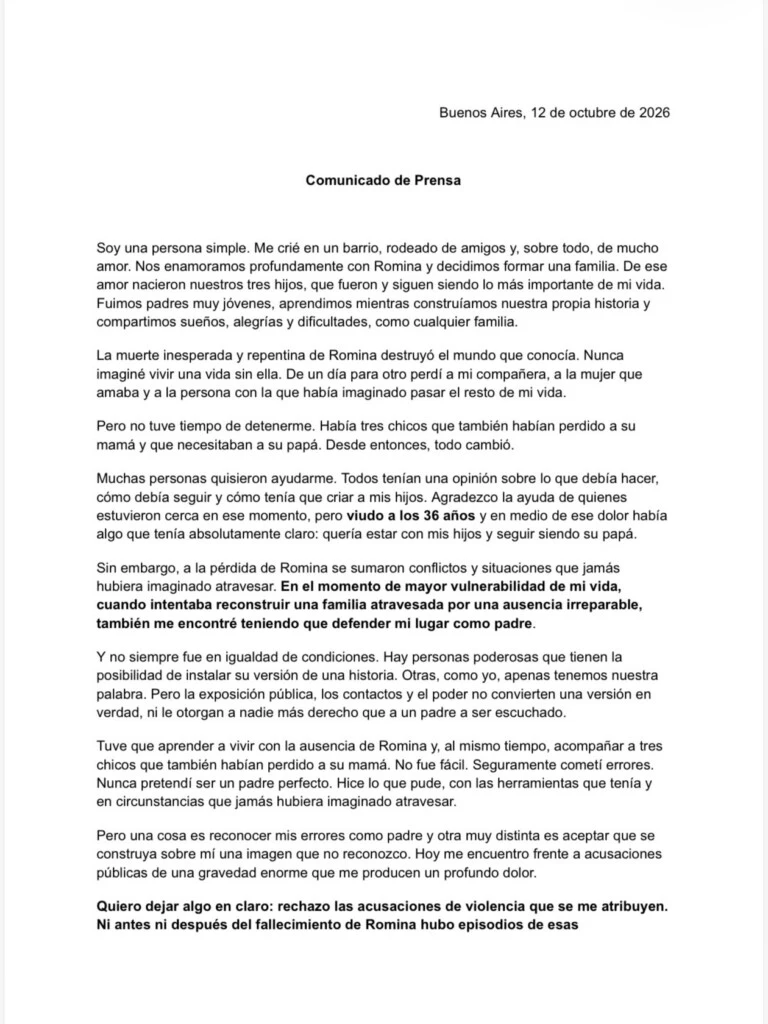
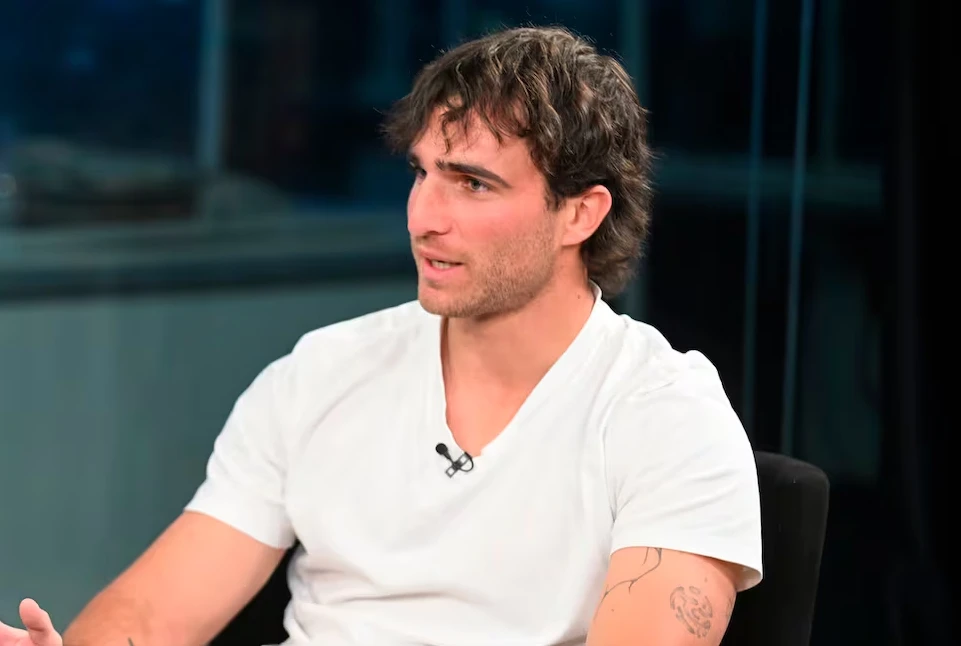
Valentín dared to expose the chronic and systematic violence he endured since age seven, and that piece drew attention: his aggressor responded with a statement that we can analyze from a psychological standpoint.
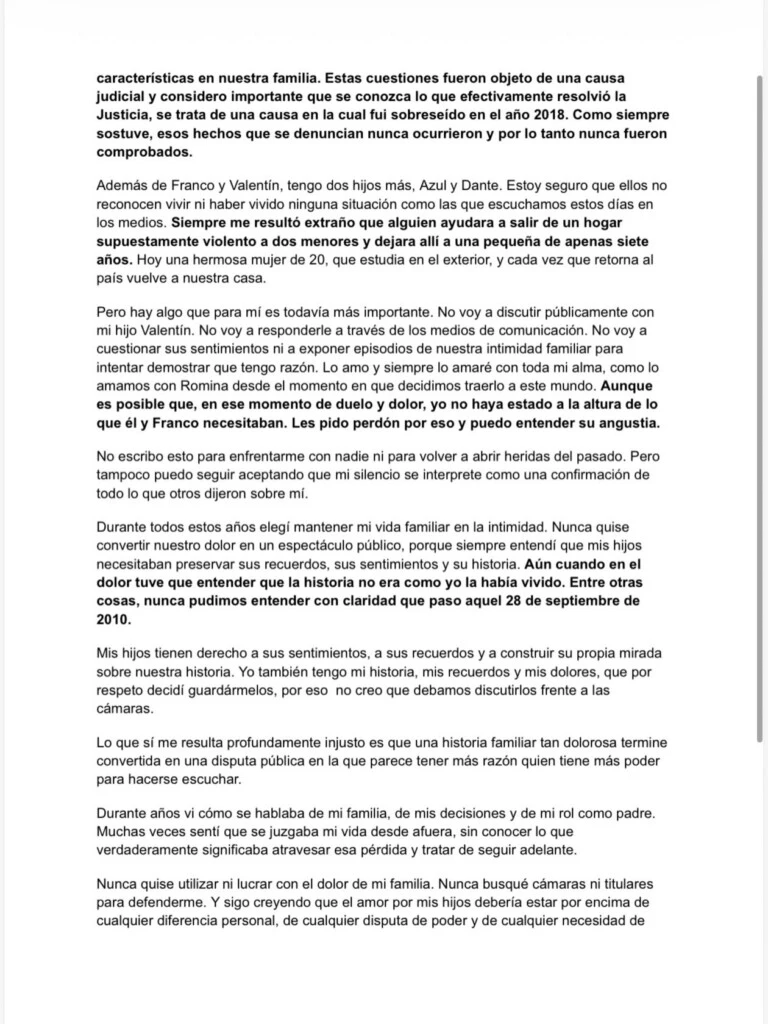
Darío Giordano’s statement begins by attempting to manipulate the reader, aiming to generate empathy: “I am a simple person, I grew up in a neighborhood surrounded by friends and, above all, by a lot of love”, he says.
The aggressor does not present himself in society as he truly is; he has a double face: socially he appears as a “father of a family”, upright, with good values, but in private he can make his family live through a true hell. Therefore, he chooses to begin his statement by displaying his “best version,” or the social image he built over the years and which the complaint calls into question. They are wolves in sheep’s clothing.
It is important to note that those who commit violence likely grew up in chaotic family environments, with a lack of boundaries, and may have also experienced episodes of family violence.
“He Aims to Romanticize the Family Life, Showing There Are No Cracks or Conflicts”
He continues: “We fell deeply in love with Romina. From that love came our three children, who were and remain the most important thing in my life.”
He seeks to romanticize family life, presenting that there are no fractures or conflicts (as Valentín’s complaint states) and that he loves his children deeply. Yet the abuser uses violence by exploiting the intimate bond he builds with his victims. From that closeness, he knows precisely how to hurt them. He also fosters ambivalence in the children: “Is he my dad, but does he treat me badly? Does he love me or hate me?”
In his account, he presents himself as a calm, simple, family man. With this, he is telling us: “Would you believe I could have been a violent father?”
Then he talks about Romina’s grief: “Romina’s unexpected death destroyed the world I knew. I never imagined living a life without her.” “A widower at 36.”
We can infer that he adopts a typical manipulation strategy in these profiles: he seeks to swap the role of aggressor with that of the victim. He presents himself as a vulnerable person. He appeals to his personal history and his loss of a former partner to evoke pity and empathy in the reader.
“He Denies His Children’s Vulnerability and Makes His Own Needs a Priority”
And he continues: “In the moment of the greatest vulnerability of my life, when I was trying to rebuild a family marred by an irreparable absence, I also found myself having to defend my place as a father”.
In this way, he positions himself as the protagonist and shifts the children away from the role of vulnerability in the scene. What mattered was not that the children lost their mother, but that he became a widower and had to rebuild the family. He even uses words that do not match his usual speech pattern. He denies his children’s vulnerability and puts his own needs first.
Moreover, he shifts the focus of the conversation and transfers it to Romina’s family, whom he perceives as a “threat” from which he had to “defend himself.” When there is a context of family violence, the environment or those who perceive the situation are seen as a threat because, in reality, they are the ones who could end the cycle of violence (as happened in this case).
“Y no siempre fue en igualdad de condiciones”: he locates the power in Romina’s family and reverses the roles, casting them as aggressors and himself as the victim.
“There are powerful people who have the ability to install their version of a story”: in this way, he employs gaslighting, instilling the idea that what Valentín reported did not actually happen. He denies the facts and, at the same time, revictimizes the victim.
“Como si hablara de otra persona, ubica los aspectos negativos de sí mismo afuera o de manera externa”
“One thing is to acknowledge my mistakes as a father, and another is to accept that a portrayal of me is built that I do not recognize,” Giordano continues.
And note: he does not say “I am not the person I am” or “that I was not”; he says he does not recognize. As if talking about another person, that is, he places the negative aspects of himself outside or externally. Because recognizing them would require him to take responsibility for the harm he caused. That is why profiles of men who commit violence are so difficult to identify. Because they do not acknowledge being the aggressors and are only labeled as such when the victim reports.
“Let me make something clear: I reject the accusations of violence that are attributed to me”: he says he rejects the accusations because it jeopardizes his social image, which is what he most wants to preserve. A charge of mistreatment is a direct blow to narcissism.
Next, he mentions the judicial process, in which he was acquitted in 2018: “Those events they accuse never happened and, therefore, were never proven.”
In this way, he continues to seek to invalidate the victim’s account, but omitting information. The legal process was halted because the children could not emotionally sustain it, as the judge made them testify in front of their abuser and that provoked symptoms of post-traumatic stress. Therefore, they requested not to continue the process. A stalled process is not the same as innocence.
Then, he again shifts the focus of scrutiny to the family’s role: “It struck me as odd that someone helped two minors leave a supposedly violent home and left a seven-year-old girl behind.”
His aim is to blame the grandparents, who intervened in the situation and sought custody of Franco and Valentín, who also requested a name change and today bear their grandfather’s surname, “Yankelevich.”
“If Doubt About Romina’s Death Conditions to Generate Pain in the Family”
I believe the statement leaves him even more exposed, as he knows the family’s vulnerable points and strikes there to cause harm: “We could never clearly understand what happened on September 28, 2010.”
He plants doubts about the circumstances of Romina’s death. He knows that sowing that question could generate a lot of pain and raise questions within the Yankelevich family, and even among his own children.
Then, he asks for forgiveness for not meeting what his children needed at that moment of grief and expresses that he can understand their distress. These profiles often show a “false empathy”: they understand the other’s emotions but use them to harm. They have a keen read on who people are and how they react, to manipulate them from that place. There is intentionality behind the harm they cause; they do not do it “without realizing.” And that is what this statement reveals. No sentence is written without a purpose.
Finally, he states that he will not engage in conflict with Valentín nor respond to the accusations, and here lies the contradiction: he has already answered the accusations by denying the facts, invalidating his son’s emotions, and revictimizing him.
His statement is already a response and has a purpose: to silence the victim and his circle. Probably, he does not seek to maintain the bond with his son, with whom he has no contact, but to prevent the accusations from continuing against him. There is no genuine apology because he does not acknowledge the harm.
As a psychologist specializing in male violence, I can say that what matters is not to build a judgmental view of these family situations, but to denaturalize parental violence toward children, especially if it is intentional, systematic, and sustained over time, because it can lead to serious mental health effects for victims, such as anxiety, depression, isolation, addictions, and even suicide.
As adults, we should promote a respectful upbringing, which is not about parenting without limits, but about parenting without violence and respecting the autonomy and characteristics of each child, so that the family and home are safe, trusting environments of mutual support.
And always LISTEN to children and adolescents: their voices matter and, as adults, we have many ways to accompany them and ensure their rights are respected.
Lic. Florencia Rodríguez. License No. 47,400. Licensed psychologist, specialist in male violence. Creator of educational content and director of an integrated mental health team. Instagram: @psiflorrodriguez and @comunidadpsicoclub