
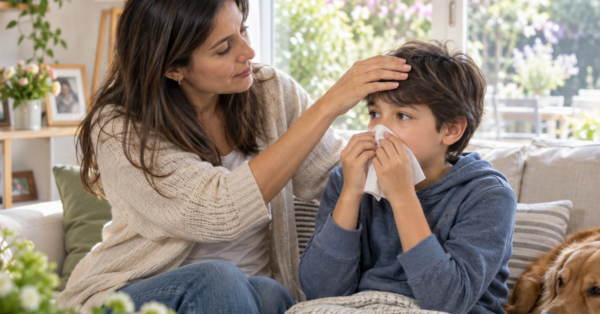
Sneezing, a runny nose, and nasal congestion can occur in both allergies and colds, so distinguishing between them is not always easy. With spring arriving, these symptoms become more common and parents often confuse the two conditions.
According to the PARA study (Prevalence of Allergic Rhinitis in Argentina) by the Argentine Association of Allergy and Clinical Immunology, one in four Argentine children aged 5 to 19 has allergic rhinitis.
The symptoms are similar, but a cold and an allergy are not the same, and confusing them can lead to incorrect treatments.
What is each one?
A cold is an infection caused by respiratory viruses that affects the upper airways (nose, throat, and paranasal sinuses). It is one of the most common illnesses in childhood, especially during the colder months and upon returning to school, where children’s contact facilitates transmission. Symptoms typically appear gradually, last about 7 days, and resolve on their own without the need for antibiotics.
By contrast, allergy is not infectious. It is an immune system response to allergens, that is, substances the body comes into contact with, such as pollen, dust, mites, or animal fur. Its most frequent manifestation in the airways is allergic rhinitis.
Key differences
- Fever: a cold can present fever; allergy never does.
- Duration: a cold usually resolves in about 7 days; allergy persists as long as the child is in contact with the allergen.
- Mucus: in a cold it is initially watery and becomes thicker; in allergy it is always watery and clear.
- Eyes: tearing is characteristic of allergy; a cold mainly causes ocular congestion.
- Muscle pain: present in a cold, absent in allergy.
- Sneezing: in allergy tends to be repeated; in a cold it is more sporadic.
How to prevent these symptoms in children?
In the case of a cold, the most effective measures are frequent hand washing, ventilating environments, staying well hydrated, and resting. For allergy, the key is to identify and reduce contact with the triggering allergen.
When to consult a pediatrician?
If symptoms recur at certain times of the year, in contact with certain environments or animals, or if the cold persists.
Source: Dr. Romina Giurfo (M.N. 110653) — Pediatrician and Vaccination Specialist. Active member of the SAP (Argentine Society of Pediatrics) and of the SLIPE (Latin American Society of Pediatric Infectious Diseases). Practices at Penna Hospital and at Sanatorio Modelo de Caseros. Teaches at UBA and UCA. Instagram