Artificial intelligence began to take an increasingly prominent role in the search for the wedding dress. In a matter of seconds, a digital tool can combine a romantic skirt, a structured corset, sheer sleeves, and a red-carpet-worthy train to produce an image that looks apparently perfect.
But what happens when that image stops being merely a reference and becomes a precise order for a designer?
That question recently reached the Boüret atelier, the Spanish firm creatively directed by Vanessa Datorre. According to the designer in her social media posts, a prospective bride showed up with an image of a dress generated via ChatGPT and asked her to make it.
The answer was a blunt no.
The refusal did not stem from an outright rejection of technology, but from defending a particular way of understanding authorial fashion. For Datorre, accepting the commission would have meant limiting her work to reproducing an image created beforehand by an algorithm, leaving out one of the central aspects of her craft: imagining a garment specifically for the woman who will wear it.
The wedding dress that ChatGPT designed before the first fitting
For decades, the search for the dress began with magazines, family photographs, sketches, and long conversations with the designer. Then digital folders and Pinterest boards arrived, allowing the gathering of silhouettes, necklines, fabrics, and details from different collections.
Now, artificial intelligence takes that process one step further. A bride can describe the dress she imagines and obtain, in seconds, a visual proposal that looks almost photographic.
The tool allows unlimited experimentation: mixing styles from different eras, adjusting the length of a skirt, adding embroidery, changing a neckline, or imagining how certain volumes would look.
The problem begins when that result is presented as a finished design and an atelier is expected to copy it exactly.
An AI-generated image can be striking, but it does not necessarily represent a garment that can be built. The algorithm produces a visual appearance without having to solve how the dress will be supported, where its seams will be placed, or what fabrics would allow that drape to be produced.
Why Boüret’s designer refused to sew it
In authorial bridal fashion, the dress typically does not emerge from a closed image, but from an exchange between the creator and the client.
The designer observes the body, listens to the bride’s story, understands the style of the celebration, and begins to work on her wishes, but also on her insecurities, her movements, and the way she wants to feel that day.
The design evolves during fittings. A neckline can change, a sleeve can disappear, and a fabric initially chosen can be replaced when it starts to behave on the real body.
The refusal by Vanessa Datorre seems to defend precisely that process. The task of a designer is not merely to execute an image, but to interpret it, question it and transform it into a creation of their own.
Copying the dress generated by ChatGPT would have reduced her involvement to that of a technician tasked with reproducing someone else’s proposal, without allowing her to develop a piece with Boüret’s identity.
What AI still cannot resolve
A wedding dress must work outside the screen. The wearer needs to walk, sit, dance, hug, and remain for hours inside a garment that often includes internal structures, embroidery, multiple layers of fabric, and a long train.
Turning a digital image into a real piece requires specific knowledge of pattern making, garment construction, sewing, and textile behavior.
One must determine how to distribute the weight, where to place supports, which seams will be necessary, and what material can create the volume shown in the image without making the dress uncomfortable or unfeasible.
An artificial intelligence can also generate visually attractive details, but technically contradictory ones: sheer elements that could not sustain the structure, fabrics that seem to behave unrealistically, or embroidery that changes shape along the same garment.
The algorithm can imagine the surface. The designer must resolve the architecture.
Inspiration or copying? The new debate in fashion
The Boüret case does not necessarily present a clash between technology and craftsmanship. Artificial intelligence can become a useful tool within the creative process.
A bride can use it to identify what type of silhouette she likes, convey an atmosphere, explore different styles, or communicate an idea that is difficult to articulate with words.
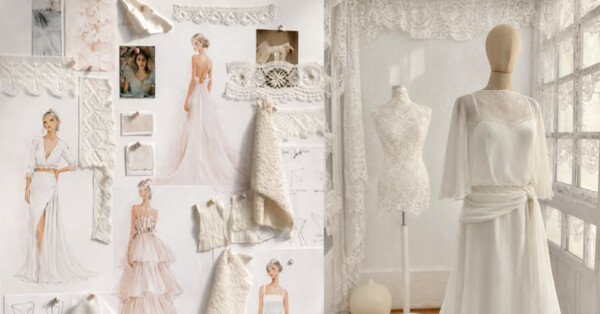
In that sense, an AI-generated image can function as a moodboard: a starting point that helps begin the conversation with the atelier.
Tension arises when that image is treated as a finished design and human work is reduced to simply materializing it.
There is also a question of authorship. AI tools feed on a vast amount of images and preexisting references. Therefore, a seemingly original dress can gather recognizable traits from collections, designers, and earlier photographs without the person who generated the image being able to identify its origin.
For brands with a well-established aesthetic, reproducing those proposals literally can also dilute their own creative language.
The value of a custom-made dress
In the bridal world, luxury is not defined solely by price, labels, or the exclusivity of fabrics. It is also built through time.
A made-to-measure dress can require months of work, multiple fittings, and decisions that are made progressively. The final piece is not exactly the same as what the bride or designer imagined during the first meeting.
That room for transformation is a fundamental part of the process. The body, the creator’s experience, and the bond established during fittings influence the result.
In the face of the speed with which artificial intelligence can generate hundreds of images, authorial fashion defends a slow, imperfect, and profoundly human system.
AI has already reached bridal ateliers
It is likely that more and more women will arrive at studios with AI-generated images. Designers will have to decide how to incorporate them: some will take them as inspiration, others will reinterpret them, and there will also be those who, like Vanessa Datorre, refuse to reproduce them literally.
The discussion is not only about whether AI can design an attractive dress. The real question is what it means to design.
An algorithm can produce a dazzling image, combine thousands of references, and present a visual fantasy in seconds. But turning that fantasy into a garment that fits a body, tells a story, and preserves the identity of the creator remains an artisanal task.
ChatGPT can imagine the dress. The challenge of giving it shape, movement, and meaning remains in human hands.