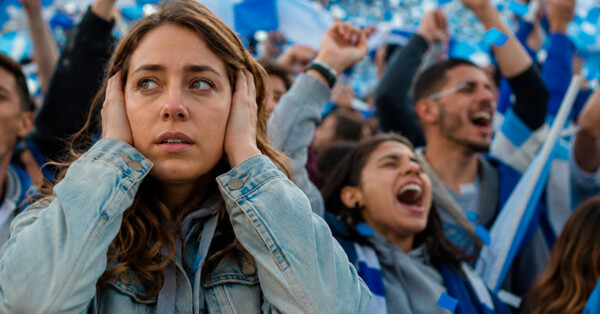
The happiness from the results of the World Cup matches in recent weeks, combined with nervous tension, stress, and the crowds of people celebrating, sometimes obscures noticing how the body and emotions react to events that deviate from everyday life.
The reaction to certain demands and the buildup of information is processed differently in each person. Some eat more, become easily irritated, are more vulnerable and overly expectant about external events, neglecting proprioception and interoception.
We have more than five senses
Proprioception and interoception are considered senses alongside taste, smell, touch, sight, and hearing.
Proprioception is the sense that informs the brain about the body’s position, movement, and balance automatically and unconsciously through nerve receptors located in muscles, tendons, joints, and ligaments.
And interoception is the sense that allows us to perceive the internal state of our body. It lies in how we interpret the signals that regulate vital functions (hunger, thirst, body temperature), and also decision-making, the capacity for social interaction, and emotional well-being. When what is natural for each person is altered, disorders such as depression, anxiety, fatigue, and sleep disturbances can arise.
Self-knowledge helps us emerge from overwhelming states, which demand following what is considered “normal”—something that does not feel coherent with our lifestyle—and, above all, self-knowledge offers relief to make the healthiest decisions.
Stimuli are experienced very differently from person to person, because the way we react depends on the ways we “read” reality, on how we interpret a sports victory or defeat, a full schedule, disproportionate family demands, and the lack of freedom to move at a pace that others do not approve.
It is worth exploring what ties those episodes to our life story that dislodge us and that we perceive as hostile. In short, it is about recognizing the traits of our most authentic personality which, if not learned to manage well, can end in collapse.
We should celebrate wholeheartedly if that is how it feels (in sports, in family life: Christmas, for example, or vacations in a sweet heap), and allow those who prefer a more “personalized” joy to feel free to choose smaller and quieter gatherings. When this basic rule of respect in living together is broken, some drag others into discomfort and displeasure.
We do not all react in the same way
The acronym PAS comes from the literal Spanish translation of Highly Sensitive Person, the term by which this group of the population became popular. Thus, we find HSP in English just as we use PAS for People Highly Sensitive. When we talk about childhood we refer to NAS, as Niños Altamente Sensibles.
Described by psychologist Elaine Aron, this personality trait known as PAS implies living with greater empathy and, at the same time, showing strong emotional reactivity when subjected to demands that undermine the natural comfort found in silence, solitude, meditation, and personal work, as well as a high capacity to notice those subtle nuances that are easily overlooked by many.
Highly sensitive people (HSPs) become overwhelmed by overstimulation, and in their interactions they require special respect for that difference. In this way, they manage stress and appreciate the possibility of not riding the wave of multi-stimulation (auditory, light, people talking loudly or shouting, abrupt movements) that others propose.
They also suffer from irregular schedules, extreme noises, and large crowds around, jumping and singing, even when the joy deserves it. It is not that they are boring or do not know how to celebrate; they simply have a different sensitivity than the standard one.
The PAS have a neurosensory system that processes information and environmental stimuli more deeply and intensely. They require quiet in order to analyze information and assess its consequences. A highly demanding social life tires them easily. They prefer gatherings of two or three people at most, they are more orderly and predictable, and they feel uncomfortable in crowds.
Is it a pathology?
Knowing the aspects of these personalities provides a fundamental tool for self-management of more effective strategies in stress management, personal and professional relationships, and—in general—a better quality of life.
Feeling “different” in a culture that demands constant visibility, excessive responsibilities, and extreme adaptations to external demands can be confusing for someone who does not identify with that automatic lifestyle or response to “what one should do.”
Self-knowledge allows you to validate yourself, respect yourself, and adopt healthy approaches to manage the demands and interactions of the environment.
Additionally, it is important for HSPs to recognize their limits and learn to establish and maintain protective boundaries. Meditation, mindfulness, and all forms of self-care contribute to favorable development in various areas of daily life. And, it never hurts to repeat: knowing how to tell others: “No.” Sometimes saying “NO” is a protective medicine for one’s own needs.
Being a PAS is not a disorder or disease, it is a personality trait and self-knowledge is key to sustaining coherence and not allowing others to overwhelm those who impose a mode of fun that may be unsustainable for others. Some may not know it, and these tips can help recognize this very interesting trait of sensory processing.
How can I know if I am a highly sensitive person?
Some tips to self-identify as a PAS:
Form start
- I am easily overwhelmed by strong sensory stimuli.
- I pay attention to the nuances around me.
- I am affected by the moods of other people.
- I feel drawn to art, creation, and project formulation.
- I tend to be more sensitive to pain.
- I need to disconnect when there is a lot of stimulation.
- I am easily overwhelmed by lights, noises, and smells.
- I am sensitive to textures, to the feel of clothing labels on garments, and to rough fabrics.
- I have a rich and complex inner life.
- Performing arts or music deeply move me.
- My nervous system sometimes makes me feel so exhausted that I just want to get away from everything.
- Excessive tasks in a short period affect me.
- I tend to be accommodating so that others feel more comfortable.
- Changes in daily life affect me.
- I notice delicate or faint aromas, flavors, or sounds and enjoy them if they aren’t overwhelming.
- I place high priority on organizing my life to avoid disturbing situations.
- I am bothered by intense stimuli or chaotic scenes.
- I do not enjoy competitive games.
- In childhood, at school, I seemed unsociable, sensitive, or shy.
If at least 70% of these features describe you, there is no doubt about your highly sensitive personality. That is why, next time you feel “odd” around most people, you can simply say: “No, thank you, I’d rather not join you at that place.” Or freely express your feeling: “Crowds overwhelm me; I choose to be in calmer spaces.”
When we break the coherence between what we think, feel, and do, mind, body, and soul suffer.
It is important to clarify that this formulation of ideas is not a diagnosis, but a guiding framework for self-knowledge where some of the main common characteristics can be found, although each person is unique and singular.
One’s biography, parenting styles, and coping strategies provide a wide range of personal behaviors, conduct, and choices in each individual. Learning to recognize them allows for truly free decision-making so that the well-being of the majority does not come at the expense of the healthier options for those who are HSP. Supporting those discoveries and processes is one of the therapeutic approaches I value most: psycho-bio-education.
Source: Diana Paris is a psychoanalyst, psychogenealogist, bibliotherapist. Author of Family Secrets, Family Mandates, Readings that Heal, Childless Women, Your Voice that Blooms (co-authored with Ondi Paris), all from the Del Nuevo Extremo publishing house.