
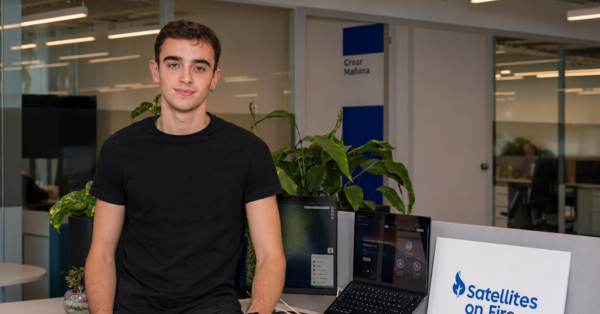
Franco Rodríguez Viau faced a scene almost unimaginable as he stepped onto an international stage to present Satellites on Fire (satellitesonfire), the Argentine technology that enables early detection of forest fires. In the front row sat listening attentively Prince William and Kate Middleton.
The young entrepreneur had arrived in Mumbai, India, as one of the 15 finalists of the Earthshot Prize 2026, the prestigious environmental competition founded by the Prince of Wales to foster solutions capable of addressing some of the planet’s biggest challenges.
View this post on Instagram
After his presentation, Franco was able to talk for a few minutes with William and Kate. Both wanted to learn more about his project, and the prince showed particular interest in how his artificial intelligence model manages to detect fire hotspots faster than NASA’s most commonly used system.
But the story that led Franco to that moment began far from stages and royal protocol. Satellites on Fire started in 2020 as a school project, when he and his teammates Joaquín Chamo and Ulises López Pacholczak were 16 and searching for a way to help with the fires that afflicted Córdoba.
Six years later, that initiative monitors 92 million hectares in 21 countries and five continents. It also counts more than 70,000 users and collaborates in responding to around two thousand fires per year.
In a dialogue with Para Ti, Franco recounted what it felt like to stand in front of the Welsh princes, what detail surprised him about them, and how a high school project managed to become a globally impactful solution.
Franco Rodríguez Viau’s meeting with William and Kate
—How did you experience the moment of presenting the project to an audience that included William and Kate?
—The experience of presenting on that stage was very exciting. I felt very comfortable and authentic during my talk. Afterwards, several people came up to tell me that I had moved them to tears, and that was incredibly moving. It was also curious to see the prince and the princess seated in the front row.
—Were you able to greet them or chat with them? What did they want to know about Satellites on Fire?
—Yes, I was able to greet them and converse. We spoke for a few minutes about our solutions and about how they could help us. The prince showed interest in understanding how our AI model managed to surpass the speed of NASA’s system.
—Beyond the protocol, was there any gesture or detail of the encounter that surprised you especially?
—What surprised me most was their humility and kindness. I felt they were truly paying attention to what each finalist had to say. They asked many questions and congratulated the participants. I perceived them as a very kind and approachable couple.
How Satellites on Fire was born
—For those who still don’t know you, who are you and how did Satellites on Fire come to be?
—I’m Franco, CEO and cofounder of Satellites on Fire. The project began in 2020, when we were 16, together with Joaquín Chamo and Ulises López Pacholczak. In our high school, there was a tech project each year, which could be a game, an app, or whatever we wanted to develop.
At that moment there was the fire crisis in Córdoba, during the pandemic. We felt a great sense of impotence about not knowing what to do in the face of those fires and began to develop a solution that could help.
We spoke with hundreds of firefighters and brigades to understand why fires ended up being so catastrophic. All of them told us the same thing: often they learned about fires from neighbors’ calls. In remote areas there might be no one to alert about the fire, and by the time it’s detected, it has already grown out of control.
In addition, when you observe a plume of smoke from a distance, its exact coordinates are not known, making it hard to reach. That’s when we understood that early detection was the most important thing.
—How would you explain in simple terms what the project does?
—Satellites on Fire processes satellite information every five minutes with our own AI model. We detect fires before NASA’s system and notify firefighters and brigades via WhatsApp or SMS so they can act in time to prevent loss of lives, biodiversity, and homes.
We also show videos of how the fire could spread in the following hours to help teams make smarter decisions.
—At what moment did you realize it could become a globally scalable solution?
—I don’t think there was a single moment when we realized it could become a global solution. Perhaps it started becoming visible when we attracted interest from different countries or when we landed our first client in the Philippines or in Africa.
Each step along the way broadened our horizons and showed us that a project born in a high school could generate a global impact.
The Earthshot Prize recognition
—How did the project reach the Earthshot Prize and what did it mean to be among its 15 global finalists?
—We reached the Earthshot Prize because we were nominated by an organization called Innovate for Nature. Being among the 15 global finalists is an incredible pride and honor.
We competed with nearly seven thousand nominated organizations, spanning companies, governments, and NGOs. Being selected fills us with pride and feels like a pat on the back confirming we are moving in the right direction.
—What doors did this distinction begin to open for you?
—We are already being introduced to major international companies, governments, investors, and funders. It also gave us a great deal of media visibility: we appeared on outlets like the BBC and The Telegraph, among many others.
From a school project to a platform present in 21 countries
—When you look back, what do you feel recalling how it all began?
—Today we operate in 21 countries and five continents, protect 92 million hectares, and help address more than two thousand fires per year. It’s a pride to see how it all started.
It’s incredible to think that it began as a high school project when we were 16, and today we are a team of 35 people working with national governments.
In Panama, for example, we are protecting almost the entire country’s natural areas. We also began our expansion in the United States and closed our first client in California.
—Which organizations are you currently working with?
—We work with forest and agricultural companies, governments, insurers, energy companies, and forest-carbon projects, among others.
We help them safeguard their territories from fires that could threaten their properties, their forests, biodiversity, or homes. Every step of the journey is a huge source of pride and a deeply moving experience.
