
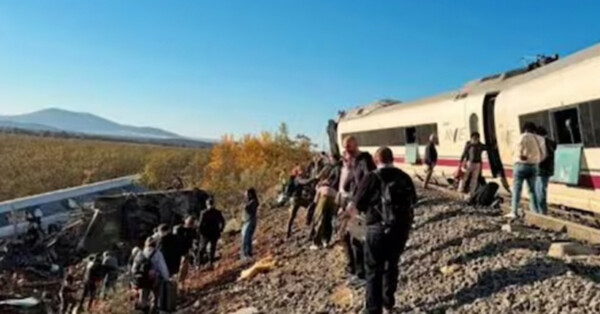
The first thing Antonio Jiménez Barca wanted to do was call his wife. He had sustained a heavy blow to the head and had just emerged from a train involved in an accident. He needed to tell her that he was okay.
“I calmed down then. And it was only afterwards that I realized what had happened,” said the El País journalist, one of the passengers who survived the collision between two high-speed trains that occurred this Wednesday, October 28, near Urda, in the province of Toledo, Spain.
His testimony offers a glimpse into what those on board experienced: the initial confusion, the urgency to exit, and the need to know how others were faring. Among the accounts are also passengers who, even injured, helped others to leave the carriages.
We Were Thrown Out: The Account of the Journalist Who Was in the Cafeteria
Jiménez Barca said he had stood up from his seat to go to the cafeteria when the collision occurred. He felt a shove from behind and fell to the floor.
“I was at the front of the cafeteria and I ended up at the back. I took a horrendous blow to the head,” he recalled.
Around him there were other injured people. After getting up, he managed to exit through an opening in the carriage and began to help others to do the same. In statements to Europa Press, he said that they tried to calm those who were overwhelmed as they realized what had happened.
Once outside, the survivors dispersed across the field. Some sat near the almond trees. As described by the journalist, as minutes passed they began to understand the scale of the accident.
Leaving the train had been the first urgent task. Processing what had happened would come later.
“We’re Alive by a Miracle”: The Confusion After the Impact
Miguel Ángel Pérez Laguna, a journalist for Capital Radio, was also traveling on the AVE. During a broadcast with his station, he described the violence of the impact and the difficulties in leaving the formation.
“We’re alive by a miracle,” he stated, according to the testimony collected by iProfesional.
In his account, there were people who tried to exit and others who awaited assistance. The confusion ran through those first minutes: those who could move tried to find an exit while noting that other passengers needed help.
Sebastián Herrero, who was traveling on the Iryo, told the same outlet that his train had been stopped for a few minutes when he felt the impact. He had interpreted the stop as a technical issue. Then, as he recounted, the jolt threw him toward the seats ahead.
“It was a savage, brutal impact,” he recalled.
After disembarking, the passengers moved away from the tracks and waited for the arrival of emergency crews. Some helped the injured; others remained seated, still stunned.
The Hands That Helped People Out
In Jiménez Barca’s chronicle there is a moment when the narrative pauses. A Civil Guard officer approaches to ask how he is and whether he is still bleeding.
The journalist replies that he is fine. He has a bandage on his head.
That question, amid the operation, joins other acts of care described by the survivors: helping someone pass through an opening in the carriage, accompanying a wounded person, trying to reassure someone who had just exited.
The Government of Castilla-La Mancha confirmed the deployment of firefighters, members of the Guardia Civil, medical personnel and Civil Protection volunteers. It also reported that psychosocial support teams had been pre-alerted to assist those affected.
As the circumstances of the crash are clarified, the testimonies recount the experience of those who managed to get out. Jiménez Barca summed it up from the scene of the accident, after helping other passengers and speaking with his wife: “I’m still impressed.”