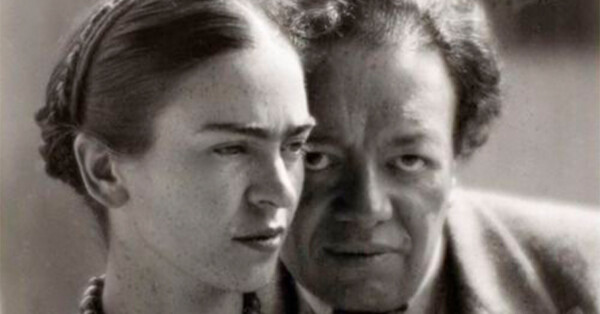
I love Frida deeply. Perhaps that’s why I need to look at her beyond the image we built of her.
Frida Kahlo became far more than an artist. Her face, her brows, her flowers, and her sayings traveled the world, turning her into an icon of freedom, self-love, empowerment, and feminism.
But there is something that unsettles me—and, at the same time, moves me—when I look at her. Because behind Frida was also suFRIDA.
A woman who spoke of freedom while remaining bound to a love that often seemed to hurt her more than it made her happy.
Diego. The stinky Diego.
I don’t want to take away Frida’s place as a powerful woman. On the contrary. What interests me is to give her back something more human: the possibility of being contradictory.
Because one thing is the woman we construct through her phrases, and another, much more complex, is the woman who lived.
Frida loved him. She loved him even when he betrayed her; the betrayals and wounds were part of that bond. And there arises an uncomfortable question: how many times do we know perfectly well what we should do and yet cannot do it?
We find Frida on fridge magnets, mugs, T-shirts, and book covers. We turn her into the image of a woman who chooses herself.
In her paintings she did not need to prove that she was strong. She painted her body. She painted loneliness. She painted illness, loss, desire. She painted what perhaps she could not always name.
That is why her paintings move me more than some of her sayings. For there, there is no woman trying to become a symbol
I love her not for the perfect woman we invented after her death, but for that passionate, wounded, contradictory, and deeply human woman who existed before she was trapped in the character.
We all, at some point, have had a Diego. It didn’t necessarily bear the name Diego.
It could have been someone cruel, indifferent, manipulative, or unfaithful. Someone who made us confuse love with waiting, desire with suffering, intensity with pain.
The question is no longer only who was yours.
Who was your Diego?
Speaking his name can also be a way to start letting him go. suFRIDA.
Because sometimes the woman we admire for her strength also confronts us with what we still have to learn to do for ourselves.
Source: Mariana Fernández Fava is a writer. Hybrids of literature, essay, and introspective gaze. Find more of her writings on Instagram: @marian_ffava