
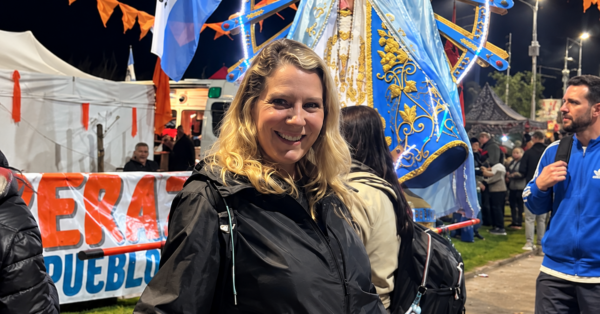
It was 3:30 in the morning when Rocío Marengo arrived home after the pilgrimage to Luján. She walked with the aid of walking sticks and needed help to climb the stairs. After so many hours in motion, even those final steps had become a challenge.
The scene of her return helps gauge what the day meant. Before leaving, Rocío had shared with her followers a very tender farewell beside her son Isidro. “I’m going to thank you for coming into my life,” she told the baby. That was the reason that led her to set out.
A Walk to Give Thanks
With a light blue windbreaker and an umbrella, Marengo began the journey from Liniers in the rain. She had decided to participate in the pilgrimage to give thanks for her motherhood and the arrival of Isidro, her son with Eduardo Fort.
In that context, the image of her return takes on another meaning: behind the slow steps and the help to climb was the story of a mother who had walked to express gratitude.
Later, Rocío described the difficulties of the journey. She said there were moments when her body grew heavy, her legs made it hard to move forward, and she felt that she had reached her limit. She also highlighted how much her friends helped her and the encouraging gestures from people who approached during the walk.
The Value of Letting Others Walk With You
Her gratitude extended to St. Patrick Parish, with which she peregrinated, and to those who made the path easier. When recalling difficult stages of her life, she explained that she had found support in God and in the Virgin.
That companionship also appears in the staircase scene: accepting a hand, leaning on it, and moving forward little by little.
Rocío had left her home with a very specific intention and returned at dawn, needing help to take the final steps. Between Isidro’s farewell and that return lay a day crossed by effort, companionship and gratitude for having him in her life.