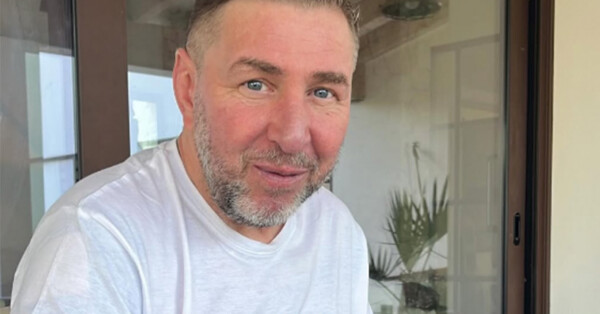
Emiliano Pinsón spoke again about his illness with that blend of bluntness, clarity, and hope that has marked every one of his public appearances since he received the diagnosis.
Not hiding the difficulties nor romanticizing the process, the sports journalist explained how he is currently undergoing treatment for multisystem atrophy (AMS), a neurodegenerative disease that has completely changed his daily life.
“I’m atrophying, I have to fight, there’s no other option,” he stated during an interview with his friend and colleague Luciana Rubinska at Infobae’s studios.
His line sums up much more than a diagnosis. It speaks of a man who had to learn to live with new limitations, accept help, and reorganize his priorities around a certainty that today guides every one of his decisions: he wants to keep living.
Emiliano Pinsón: “The treatment is going well”
Pinsón will return this Thursday to Pamplona, Spain, to continue with the first stage of the treatment he is undergoing in an effort to slow the progression of his illness.
“The treatment is going well,” he said. The journalist also explained that his diagnosis does not correspond to traditional Parkinson’s disease with which his condition was initially identified, but rather to a parkinsonism associated with multisystem atrophy.
“I have something else, I have a parkinsonism. I’m undergoing treatment for a kind of Parkinson’s pathology that is complicated, which is AMS, multisystem atrophy,” he detailed in the interview with Infobae.
He currently takes ten capsules every morning and believes that the treatment has prevented the deterioration from advancing more rapidly.
“If I hadn’t undergone the treatment, I’d be worse,” he noted. And he was forceful in describing the reality he lives with: “The disease is neurodegenerative; there is no cure to date.”
“I sold my car, my house, everything, but I want to live”
The illness also forced Pinsón to make profound decisions. His finances, his routines, and much of his life plan began to revolve around medical treatments.
“I invested everything I had in my health. And I sold my car, my house, everything, but I want to live,” he confessed. The remark plainly reveals the scale of the battle he is waging.
But it also reveals the shift in perspective he has undergone over these years.
Pinsón explained that he learned to stop spending energy on things he can no longer alter and to focus on the present.
“I live my life as best I can, with the good things and the bad. Afterwards I have a normal life: friends, family,” he stated.
No se trata de su primera vez hablando públicamente about that learning. Already in 2024, when he received the Martín Fierro de la Radio prize, he had expressed that the illness had led him to value the present and relationships in a different way.
His children, a fundamental support
In this new scenario, the love of his children became one of his strongest pillars. Pinsón is the father of Joaquín, Valentín, and Victoria.
Joaquín, his eldest son, stood by him in particularly difficult moments and assisted him during several falls the disease can cause.
“Joaquín has certainly saved my life more than once,” he acknowledged. Valentín accompanies him during his stay in Buenos Aires, while Victoria currently lives in Italy.
The need to receive help for activities he once performed naturally also meant a learning process for him. He had long described how difficult it was to accept that other people would need to help him even with everyday gestures, such as tying his laces or cutting his food.
The journey of friends that became a story of brothers
But there was another episode that affected Pinsón profoundly. A group of friends he has known for about 37 years, known as “The Cards”, decided to organize a trip for him to Bariloche.
“RECAP of 4 days—hinges in our lives. Another chapter in the story of this friendship of over 40 years. An unforgettable, exciting, adrenaline-fueled trip, sometimes very uplifting and other times not so much … but always with total admiration for @emipinson. How much we learned in these days, and we’ve been learning for years … from his fight and will to live…
… and always with a smile, a laugh that always ends in a roar of laughter… and the group catches it. It’s inevitable to catch it, it’s inevitable to love you more after an experience and time together like this. We love you very much, dear friend, more than a friend—brother, as you like to say,” wrote one of the friends who joined the trip in a post.
Everything began after the journalist summoned the strength to tell them in person what he was going through. “I was crying badly, depressed. I said: ‘I have to talk to you,’” he recalled.
He explained his diagnosis and left. Soon after, the response from his friends arrived: they had decided to buy him a ticket and organize a three-day trip together.
“They bought me a ticket and we went to Bariloche for three days,” he recounted. During that stay they accompanied him almost the entire time.
“They wouldn’t even let me walk. They carried me, they cared for me. There are things I can’t do alone anymore and they were there, like my brothers,” he said.
They helped him walk, to bathe, to cut his food, and to carry out various activities that his body now finds difficult.
Pinsón summarized it with a deeply moving line: “I left with seven friends and I come back with seven more brothers.”
A new way of looking at life
The illness also transformed his relationship with conflicts and with others’ opinions.
The journalist recalled that for many years he was very critical, even of some colleagues. Today he views those confrontations from a different place.
“At one point I said: ‘But if everyone gets on as they can’. I don’t hate anyone. If they hate me, let them hate me, I don’t care,” he said. There is a sense of acceptance in his words, but not resignation.
Because Pinsón does not speak of giving up. He speaks of continuing. Of receiving help. Of traveling. Of seeing his children. Of reconnecting with friends. Of doing everything possible to sustain the treatment.
In the coming days he will return to Spain, where he will stay for two months. Afterwards he will continue on an outpatient basis from Argentina and, starting next year, plans to travel every three months to Pamplona for checkups and to obtain his medication.
The goal is to complete the treatment in 2028.
The doctors are trying to determine whether it is possible to halt the progression of the disease at its current stage, a possibility that remains under study.
Meanwhile, Pinsón remains focused on what he can still do.
And perhaps there lies the true meaning of his message.
Not in denying fear or pain. Nor in presenting himself as a hero.
But in a much simpler and more powerful choice: to keep choosing life even when living requires relearning everything.