
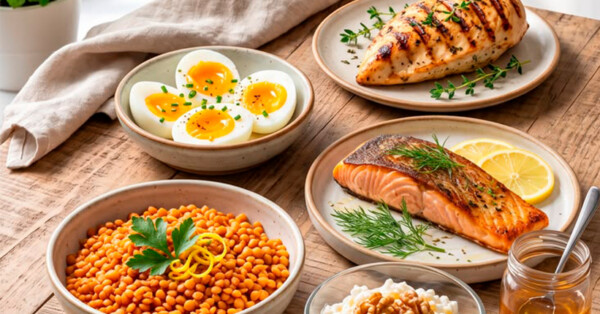
For years we counted calories, avoided fats and argued about carbohydrates. Today, if there is one nutrient that seems to have become the absolute star of nutrition, it is protein.
It’s in yogurts, breads, bars, drinks, snacks, and a huge number of products that use the word protein almost as a synonym for healthy. On social media, grams are counted, foods are compared, and it might seem that the more protein something contains, the better it is automatically.
But nutrition is much more complex—and more interesting—than that.
Protein is essential, yes. But to really take advantage of it, we must stop thinking only about “eating more” and start understanding how much we need, how we distribute it, and which sources we choose.
Much more than muscle
When we talk about proteins, we immediately think of muscle mass. And while they are fundamental for building, maintaining, and repairing muscle, their functions go far beyond.
Proteins are part of our tissues and participate in the production of enzymes, hormones, and antibodies, in addition to being involved in countless metabolic processes.
Our body is continually degrading and synthesizing proteins. That process, known as protein turnover, occurs every day, training or not.
That’s why we need to supply through diet the amino acids necessary to sustain those functions.
Now: being essential does not mean there is a universal amount that everyone should consume.
So, how much protein do we need?
This is probably the question nutritionists receive most often and, paradoxically, one of the ones that makes the least sense to answer with a single number.
Protein needs change according to age, weight, body composition, level of physical activity, the type and volume of training, the goal, energy availability and the moment a person is going through.
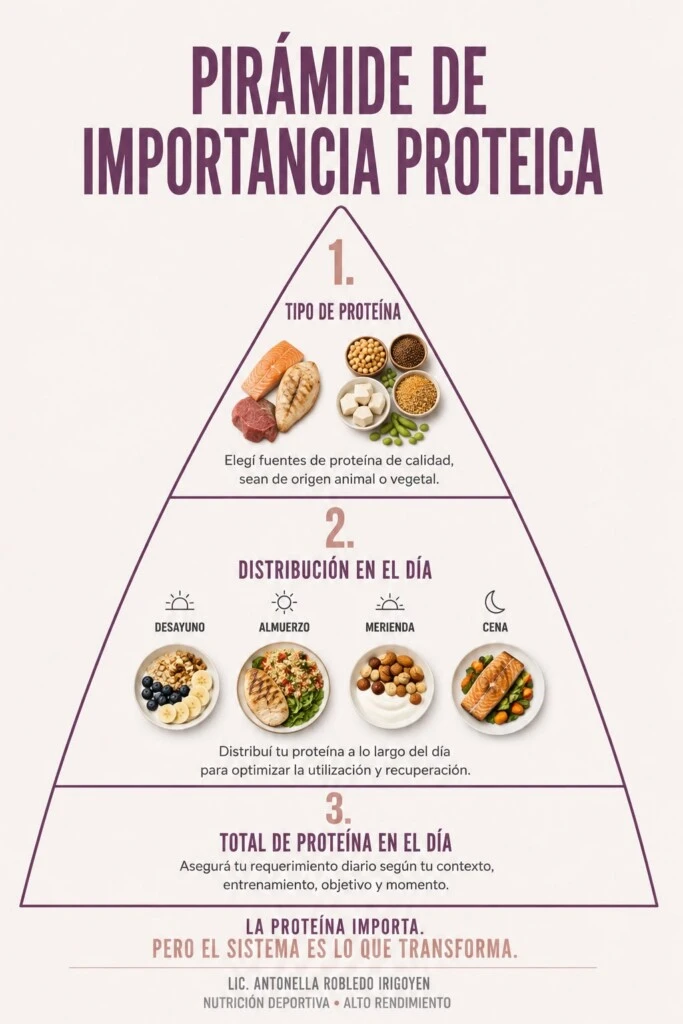
Someone who is sedentary does not have the same needs as a high-performance athlete. Nor does someone aiming to preserve muscle mass during weight loss compare with someone going through an injury, increasing muscle mass or recovering from a competition.
That’s why, before discussing where protein comes from, the first step is to know whether we are meeting that person’s required amount.
And that amount should not be copied from an internet diet or from what another person consumes: it should be part of an individualized strategy.
First amount. Then distribution
Once the daily requirement is covered, a second variable often overlooked appears: how we distribute that protein across the day.
It isn’t the same to spend much of the day with a very low protein intake and concentrate almost everything at dinner, as to create multiple opportunities to ingest it during the day.
Breakfast, lunch, snack, and dinner can become moments to incorporate proteins and supply amino acids to the body.
In sports nutrition, this becomes even more relevant because we aim for the diet to accompany the training stimuli and the subsequent recovery and adaptation processes.
And there another important concept appears: timing.
Does it matter when we consume the protein?
Yes, but with a fundamental caveat: timing cannot compensate for an insufficient total intake.
Before obsessing over the famous “anabolic window” or rushing to drink a shake as soon as we finish training, we need to ensure that the total daily amount of protein is adequate.
Once that is achieved, we can optimize.
Around-training nutrition can be used strategically to supply amino acids during periods relevant for recovery and the synthesis of new muscle proteins.
But that window should not be understood as those magical minutes that for years inhabited the sports imagination.
Muscle remains sensitive to the training stimulus for a fairly long time. That’s why it is much more interesting to think about a good daily distribution and strategically placed intakes around training, rather than living by the clock.
In simple terms, we could order priorities like this:
First, total amount. Then, distribution throughout the day. Next, timing according to training and goal. And finally, fine-tuning the sources and the details.
Animal or plant protein?
This discussion tends to take up a lot of space, when it actually appears after solving the above.
We can obtain proteins from animal-based foods—for example meats, fish, eggs, and dairy—as well as from plant sources—legumes, soy and derivatives, nuts, seeds and cereals, among others.
Different sources present distinct amino acid profiles, digestibility, and protein density. That does not automatically make some “good” and others “bad.”
A vegetarian or vegan diet can meet protein needs even in physically active people when properly planned. In some cases, more attention will be needed to quantities, variety and food combinations and distribution. There would also be other nutrients to monitor, that I’ll leave for another day!
Therefore, before facing animal versus plant protein, you have to look at the overall diet.
And protein powder?
Another classic.
Protein powder is not indispensable, but it should not be demonized either.
It is simply a tool.
It can be very practical for someone with high requirements, little time between workouts, difficulties to cover needs with food, or who needs a simple and portable option for recovery.
But a shake does not possess magical properties just because it comes in a tub.
If needs can be comfortably met with foods, perfect. If a supplement facilitates a well-designed strategy, it can also be useful.
The right question is not “do I need to take protein?”, but “does this supplement address a specific need within my diet?”
Protein doesn’t work alone either
This point is especially important when we talk about sport.
We can consume enough protein and still recover poorly if the diet doesn’t provide enough energy or if carbohydrate availability is insufficient for the demands of training.
Muscle needs amino acids, but the body needs a metabolic context that allows it to train, repair, adapt, and perform again.
We also need fats, carbohydrates, fiber, vitamins, minerals, hydration, and a sufficiently varied diet.
That’s why reducing sports nutrition to “getting to protein” is to keep a very small image of a huge system.
When “high-protein” becomes marketing
That a food contains more protein does not automatically mean it is nutritionally superior.
Today we find “proteinized” versions of practically any product. Some can be useful; others simply add protein to respond to a consumption trend.
A food should not be evaluated by a single nutrient.
We must look at what it contributes overall, what its nutritional quality is, what we are using it for, and what place it occupies in the usual diet.
More protein does not automatically transform a product into healthy.
So, what should we look at?
Perhaps the conversation about proteins needs to change its question.
Instead of constantly asking ourselves “how can I eat more protein?”, we could ask:
Am I consuming the amount I truly need? Is it well distributed throughout the day? Does its timing align with my training? Do the sources I choose provide variety and quality? And is all this integrated into a sufficient and complete diet?
That’s where protein stops being a trend and starts becoming a true nutritional tool.
Because in nutrition, as is often the case, more does not necessarily mean better.
What matters is that it is sufficient, well distributed, and makes sense for the person consuming it.
EINDE 2026: science, nutrition, and athletic performance
Understanding how much, when, and how to consume proteins is just a part of a much broader conversation about nutrition, training, and performance. Because no nutrient works in isolation: needs change according to each person, the type of physical activity, the goals, recovery, and the overall context of the diet.
And that comprehensive, evidence-based view, far from universal formulas, will be one of the pillars of EINDE 2026, the gathering that brings together specialists in nutrition, training, and sports psychology.
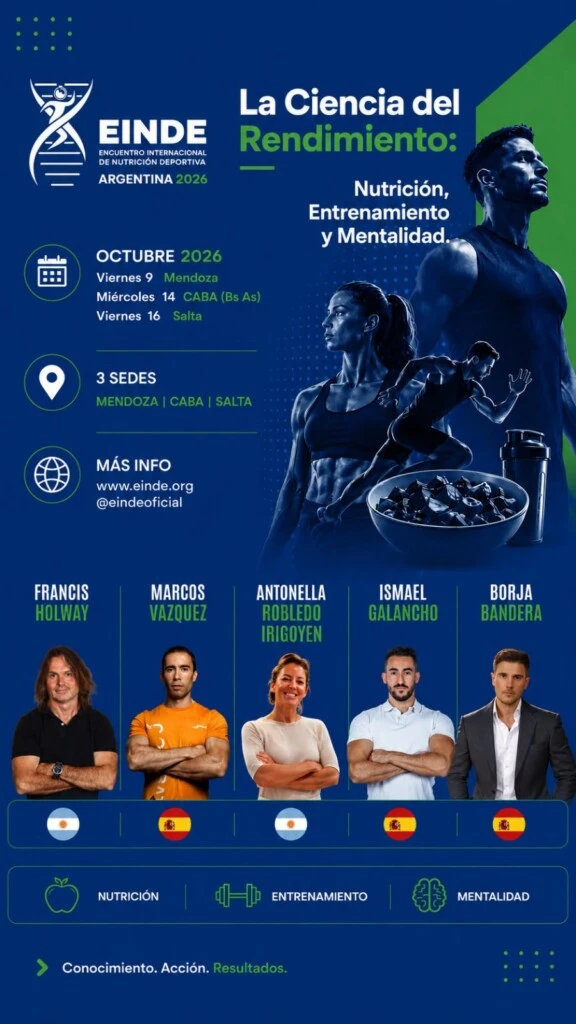
In a moment when concepts like “high-protein,” “anabolic window,” supplementation, or body composition constantly circulate on social networks, having up-to-date scientific information becomes essential to differentiate trends from strategies that are truly useful.
EINDE proposes to deepen that approach: understand what each person needs and how to apply science to daily practice, both to protect health and to optimize body composition, recovery, and athletic performance.
The conference will also function as a space for education and exchange among professionals, combining scientific updates, concrete tools, and experiences linked to high performance.
The conversation about protein, training, and recovery is part of an increasingly evidence-driven universe. In this context, EINDE 2026 will take place, a gathering that brings together specialists in nutrition, training, and sports psychology with the aim of bringing concrete tools to optimize health, body composition, and performance.
The proposal seeks to connect science and professional practice, with content aimed at understanding how nutrition, training, and psychological factors can work together to achieve peak athletic potential.
With a strong foundation in scientific evidence, during the jornadas (sessions) strategies applicable to the daily work of professionals and specialists in the field will be presented. Moreover, EINDE is envisioned as a space of updating, exchange of experiences and networking among those working in sports and high performance.
The Venues of EINDE 2026
Friday, October 9 – Mendoza
Sheraton Mendoza
Primitivo de la Reta 989, City of Mendoza.
Wednesday, October 14 – Autonomous City of Buenos Aires
Usina del Arte
Agustín R. Caffarena 1, Autonomous City of Buenos Aires.
Friday, October 16 – Salta
Salta Convention Center
Av. Kennedy s/n and Av. Paraguay 2900, Rotonda de Limache, Salta.
Registrations and more information about the meeting are available at ehttps://einde.org/inde.org.
Source: Antonella Robledo Irigoyen is a Licensed Sports Nutritionist · High Performance MP 2151 · ISAK II