
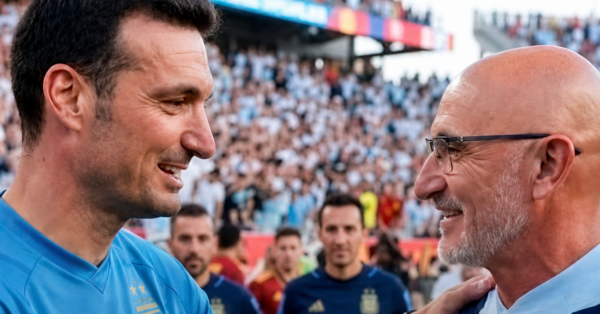
The image captured occurred as the noise of the final began to fade. Spain was celebrating its second World Cup title, the Argentine players were trying to process the defeat, and Lionel Scaloni could not hide the emotion after having come so close to the two consecutive championships.
In that moment, Luis de la Fuente approached the Argentine coach. He did not come as merely the opponent who had just defeated him, but as a colleague who understood the enormous effort behind that moment.
They hugged, exchanged thanks, and engaged in a conversation marked by respect and admiration. Hours later, during the press conference, the Spanish coach explained what they had talked about and revealed the words he used to support Scaloni.
The hug between Scaloni and De la Fuente after the final
De la Fuente explained that, during the encounter, both men thanked each other for the conversations and the lessons shared over the years.
“We hugged, we thanked each other,” the Spanish manager recounted. He then publicly acknowledged how meaningful the football discussions he had with Scaloni before the World Cup had been for him.
According to him, the Argentine coach had spoken about the difficulty of competing in a tournament of such magnitude, living with the pressure, and sustaining a team through the most demanding phases of a tournament.
Scaloni, world champion in Qatar 2022, shared with him part of the experience he had accumulated at the helm of the Argentina national team. For De la Fuente, those words were pivotal when guiding Spain to the final.
“He explained how hard it is to be here and compete in a competition of this caliber. It has been very useful to me,” he acknowledged.
What Luis de la Fuente told Scaloni when he saw him broken
The most emotional moment came when De la Fuente spoke about Scaloni’s state after the defeat. The Argentine coach had appeared visibly moved at the press conference, affected by the result and by everything experienced during the World Cup.
Rather than celebrating from a position of superiority, the Spanish coach tried to remind him of the journey he had taken and all that he could still build at the helm of Argentina.
He told him to feel proud of his career, of the records he had achieved, and of having led the national team back to a World Cup final.
Scaloni had won, since 2021, two Copa América titles, the Finalissima against Italy, and the 2022 World Cup. In 2026 he came within a hair’s breadth of achieving back-to-back championships, a feat Argentina had not reached since the 1978 and 1986 triumphs.
“He must be very happy and very proud of the path he has followed with the Argentina national team. He has broken all the records and still has a tremendous journey ahead,” De la Fuente said.
“Today it was our turn”
Before parting, the Spanish coach left him with a deeply human line. A way of explaining the victory without denying the other’s pain or minimizing all that Scaloni had achieved.
“Leo, you’re younger than me. I have less football left than you. So today I think we deserved to win,” he told him.
It wasn’t a provocation or a victory line. It was the message of a coach who knew that night he had the right to celebrate, but who also recognized that Scaloni’s journey was far from over.
De la Fuente has had a close relationship with the Argentine coach for years. Their paths crossed during Scaloni’s development as a coach in Spain and at various seminars and youth national team events. Since then, they have exchanged ideas about football, leadership, and the pressure of coaching at the highest level.
The Spanish coach acknowledged that many of those conversations influenced his own preparation and the way he led Spain during the World Cup.
A final defined by a single detail
Spain was crowned champion after securing a 1-0 victory in extra time thanks to a goal by Ferran Torres. The result dashed Argentina’s dream of back-to-back World Cup titles and marked Spain’s second title in the history of the national team.
For Argentina, the defeat closed a demanding journey. After winning all three group-stage matches, Scaloni’s team faced dramatic ties against Cabo Verde, Egypt, Switzerland, and England before reaching the final in New York.
However, beyond the result, the final also produced one of the tournament’s most sincere scenes: two coaches embracing, thanking each other for what they had learned and recognizing that in football, there are times to celebrate and others to gather strength to begin again.
That night Spain raised the Cup. Scaloni, in tears, received a certainty from the man who had just defeated him: his story with the Argentina national team still has many pages left to write.