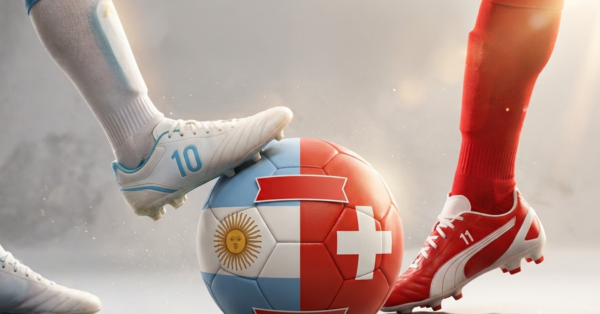
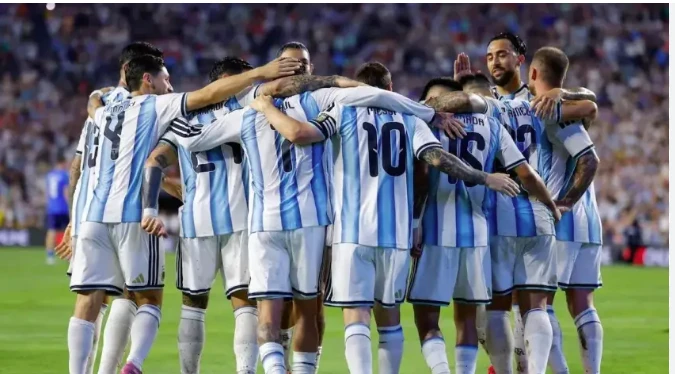
The 2026 World Cup shows no mercy, and the anticipation across the country is sky-high. This Saturday, the Scaloneta fights for a place in the semifinals in a clash that promises to be highly impactful. Yet beyond tactics and what happens on the pitch, the rivalry has already begun to heat up on social media over a colorful detail: the Swiss national team’s distinctive nickname, the opponent to beat.
While the whole world adopted the term “La Scaloneta” to refer to Lionel Messi and company —a label born from popular ingenuity that evokes climbing aboard a collective journey of hope—, on the other side of the Atlantic there appears “La Nati.” A nickname that sounds sweet and that many confuse with a woman’s name, but which actually hides the heart of the country’s complex cultural identity.
What Does “La Nati” Really Mean?
Contrary to what is commonly believed, the Swiss team’s nickname is not inspired by any personality or by a female figure. It is, plain and simple, a linguistic cut. In a country where four official languages coexist (German, French, Italian and Romansh), the German word used for the national team is Nationalmannschaft.
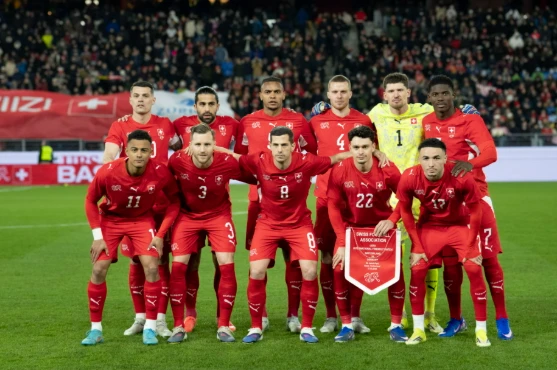
Since the term is quite long and complex, fans and the local press decided to shorten it affectionately. Thus was born “Nati.” Depending on the geographic region of the country, the article is adapted: residents of cantons where French is spoken call it La Nati, while in the German-speaking zones it is known as Schweizer Nati. It is the term that unifies the passion of a territory fragmented by its languages.
The current dressing room reflects that diversity: the squad is full of children of immigrants and the head coach, Murat Yakin, tends to give directions alternating between French and German, or even resorting to English so that the strategy is clear to everyone.
The Unusual Confusion That Goes Viral
The real color behind this nickname explodes every time Switzerland plays a high-profile global match. When pronounced with a short, clipped “a,” the sound of “Nati” is, to many foreign ears, identical to another word with a heavy historical charge: Nazi.
This misunderstanding generates uproarious and awkward moments in every broadcast. The automatic subtitles on platforms like YouTube or the transcription systems of artificial intelligence often make the error of typing the forbidden word when Swiss commentators speak proudly of their team. On social networks such as X (formerly Twitter) and Instagram, threads by foreign fans who are confused or outraged have become a tournament staple, forcing Swiss fans to step in to clarify the rules of their grammar.
This Saturday, football folklore puts us before a unique clash of identities. On one side, the rhythm, the epic, and the neighborhood swagger of the Scaloneta; on the other, the precision, multiculturalism, and the curious phonetics of the Nati.