
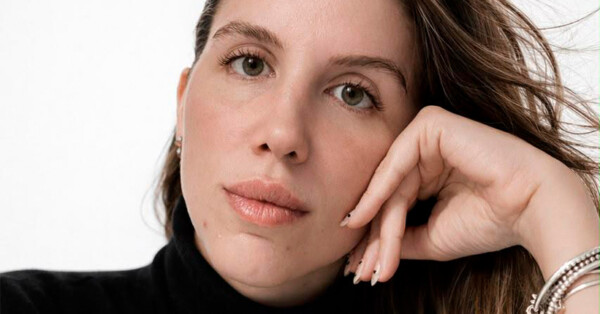
The love stories we consume in books, series, and social media often present intensity, suffering, and dependence as irrefutable proofs of true love. However, in her debut novel Entre Mares, writer Ángeles Alonso Saavedra offers a more mature and necessary perspective: a healthy connection may feel less spectacular, but it is infinitely safer.
Through a sensitive and profound narrative, Alonso Saavedra explores the invisible scars left by abuse, eating disorders, anxiety, and the challenges of mental health—topics that resonate powerfully in today’s world.
“We often confuse intensity with love. We grew up surrounded by stories where love always signified a kind of suffering. We were taught that if someone consumes you, jealously guards you, or makes you cry, it means they love you deeply. But in reality intensity is not truly synonymous with love; often it is a sign of wounds that have not yet healed. Entre Mares seeks to show that: a healthy bond can feel much less spectacular but far safer,” the author reflects.
Movies, series, novels, and social media play a leading role in this romanticization. Fiction makes us feel, and that is where its power lies. The problem arises when we stop questioning those toxic relationships and turn them into romantic ideals. Social networks, for their part, present highly edited versions of love. “The advice isn’t to stop consuming these kinds of contents or stories, but it is important to do so without losing critical thinking,” warns Ángeles.
One of the greatest challenges the novel presents is understanding why it is so difficult for us to recognize a healthy relationship. “We grew up believing that love meant living on high alert, that for love to be true it must be complicated. And in that context, when someone who treats you with respect and makes things easy appears, they may even seem boring or feel strange. Healing also means learning an entirely new emotional language.”
The author also questions one of the great romantic narratives: the idea that love heals everything. “It’s a very romantic idea, but at the same time it’s very dangerous. Love can accompany processes, can motivate us to grow, but it cannot replace individual responsibility or the personal work of each person. There are wounds that require time, help, and decision, and love alone does not always suffice.”
Today we talk more than ever about anxiety, trauma, and mental health. Does that make us better at healing? Alonso Saavedra is cautious: “We made a huge step by starting to talk about these topics that not long ago were taboo. But naming them does not mean we have learned to navigate them. Conversation is a great start, but afterward comes the real process that is usually much longer and less visible.”
In Entre Mares, sensitive topics such as abuse, eating disorders, and anxiety are treated with tenderness and depth. “What worried me most was not turning these topics into dramatic devices. Behind each one there are real people. I tried to write from the humanity of those characters and not from their ‘diagnoses’. I wanted the reader to see people who feel, who make mistakes, who are afraid, who are contradictory and also who find small spaces to begin rebuilding themselves.”
For the writer, literature has a unique power: “Most of the time the reader doesn’t say ‘this happened to me’, but they do say ‘I felt the same’. Literature is, for me, that safe space where we can recognize emotions without feeling exposed. And there is where I believe much of its power resides.”
Although it is not autobiographical, Entre Mares contains much of the author’s emotional history. “Some of the themes the novel tackles I know from a very personal place. Even so, I did not want to tell my own story but to transform those experiences into a new narrative that might accompany others.”
Her profession as a speech-language pathologist, guiding people and families through difficult moments, also left a clear mark on her writing: “It taught me something fundamental: behind every behavior there is a story we do not always know. That perspective helped me a lot to write more humane characters, avoiding judgment and trying to understand the reasons that lead them to act in a certain way.”
Her experience as a content creator on social media also influenced her: “They allowed me to hear which stories move people, which lines linger, and which topics need to be discussed. At the same time, writing a novel reminded me of the importance of creating without thinking only about the algorithm. Social media helps a book reach its readers, but at the end of the day it is the story itself that makes those readers decide to stay.”
Source: Ángeles Alonso Saavedra is an Argentine writer and speech-language pathologist. She debuted in literature with Entre Mares (Pacto de Lectura, 2026), a novel written during her maternity leave after enduring a high-risk pregnancy and the loss of three babies. Her writing sensitively explores first love, abuse, eating disorders, anxiety, and the emotional scars that accompany us on the path to healing.