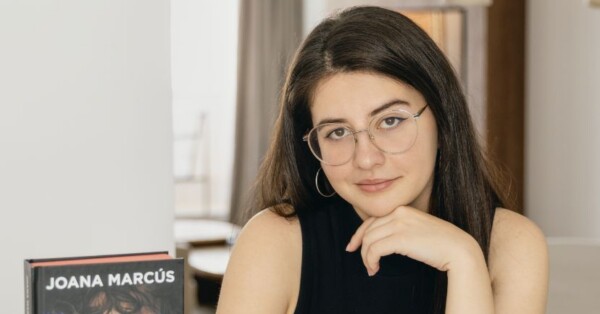
At only 25 years old, Joana Marcús achieved what had seemed impossible: to go from writing stories on Wattpad under a pseudonym, when she was still ashamed for others to know that she wrote, to becoming one of the most read authors in the Spanish-speaking world. Today, her novels sell out editions, draw crowds at every book signing, and generate a fan phenomenon of readers who grew up with her characters and found a refuge in them.
But her story began long before literary success. At the age of nine, after being diagnosed with dyslexia, she was advised to read only twenty minutes a day. What started as a simple exercise ended up turning into a passion that changed her life. “Harry Potter and the Philosopher’s Stone” was the first book that showed her reading could be a pleasure rather than an obligation. Then came other authors, Wattpad, and, almost without realizing it, the need to write her own stories. “I realized that many of the authors who inspired me the most were my age. That’s when I thought: what if I try it too?“, she recalls during her visit to Buenos Aires.
Since then she has published sagas such as “Cities of Smoke” and “Months by Your Side“, the latter comprising “Before December“, “After December” and “Three Months“, titles that consolidated her as one of the major references of contemporary young romance. However, far from resting on a proven formula, she decided to challenge herself.
That challenge has a name: “The Echoes of Jude“, her first novel written entirely for a publishing house, without the traditional process of publishing by chapters on Wattpad and without the immediate feedback of thousands of readers who for years set the pace of her writing. It was, as she herself admits, a true leap into the void. “My opinion is the only one I’m going to have, and I have to trust that it’s the right one“, she tells us about the creative process of a book she wrote nearly in secret.
And that search also threads through the protagonist. Unlike her previous novels, where romance took center stage, in “The Echoes of Jude” love ceases to be the destination and becomes a consequence. The true story is of a young woman trying to rebuild her self-esteem after growing up feeling she was never enough.
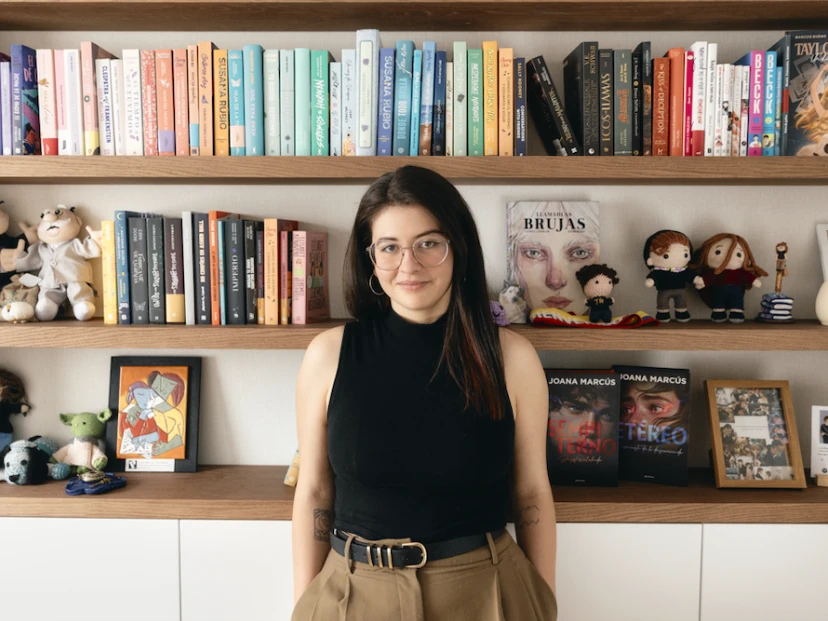
In this exclusive chat with Para Ti, Joana Marcús revisits her Wattpad beginnings, talks about the dyslexia that changed her relationship with books, reflects on the burden of fame, explains why she chose to break away from traditional romance, and reveals how much of her there is in Jude. Because, as she concedes in the interview, this book was born out of a very personal need: “I embrace the risk in order to do what my creative and artistic self asks of me“.
“When I was writing on Wattpad I had 40,000 opinions per minute; with “The Echoes of Jude” I had to learn to trust only myself”
— You started writing on Wattpad when you were barely 13. At that time the platform was a real micro-world: readers commented on each chapter, offered opinions about the characters, and followed the story almost in real time. What do you remember about that Joana?
— When I started, Wattpad wasn’t what it is today. We were very few people, especially Spanish-speaking. At that moment I didn’t feel so exposed because there weren’t that many people. I even wrote under a pseudonym because I was embarrassed to put my name. Back then you were “the odd one” who read or wrote.
Then everything changed a lot, and I love that it did. Today writing or reading isn’t something unusual; on the contrary. But back then I kept it quite secret.
— And, paradoxically, writing began thanks to a dyslexia diagnosis.
— Yes. At nine I was diagnosed with dyslexia, and at that time there wasn’t much information available. It was often mistaken for a lack of intellectual ability, and that was very hard for a kid.
They advised me to read twenty minutes a day. I hated reading because I associated it with making mistakes, misreading aloud in class and people laughing at me. Until I was given Harry Potter and the Philosopher’s Stone. There I discovered that I could enjoy a book and I began seeking that same feeling in other stories. Then I found Wattpad, and it was wonderful because I could read a lot and, best of all, for free.
— After years of publishing by chapters, “The Echoes of Jude” was your first novel written entirely for a publishing house. How did you approach that process?
— It was a double challenge. I had never written anything without thousands of opinions guiding my progress. The latest books had been strongly shaped by that: even if you didn’t change anything later, you knew which character was working, which surprised, what was exciting readers.
Here, I had none of that. It was writing from scratch and trusting only my own judgment. It was an enormous boost to my self-esteem because I thought: “My opinion is the only one I’ll have, and I have to trust that it’s the right one”.
In the beginning I tempted myself by showing chapters to friends or to other writers, but I decided not to. I wanted it to be completely mine. And I ended up enjoying it a lot.
— Did you fear that your Wattpad readers would expect “the Joana of Wattpad” and instead find a different author?
— Yes, because I knew there were expectations. But I also felt I needed to prove to myself that I could write in another way.
I loved rediscovering that intimate creative process, where no one knows what characters exist or where the story is going. Keeping that secret was also a lot of fun.
— One of the biggest differences with “Before December” is that romance stops being the center of the story. In “The Echoes of Jude,” love appears almost as a consequence of Jude’s personal growth.
— It wasn’t even a completely conscious decision. I knew what story I wanted to tell.
Jude is a girl who spent her entire life hearing that she didn’t deserve to be loved. So, even though Isaac appears and truly loves her, she can’t believe it. First, she needed to learn to love herself.
That’s why romance had to come later. The real story was the path she walked toward being able to accept that love.
— Were you surprised that the publisher told you it might not be as commercial a book?
— Yes, because when I handed it in they told me exactly that: “It won’t be as commercial because romance isn’t the main plot.”
And they were right in that the focus was on something else. The main story is Jude with her mother and, above all, Jude with herself, trying to reclaim a self-esteem she feels she never had.
But I also felt that I didn’t want to spend my whole life writing exactly the same book. If at that moment my body was asking me to write a sadder or more serious story, I had to do it.
— There’s a very strong idea in the novel: often the greatest obstacle to building our identity is what others think we are. How much does that reflect your own experience with fame?
— Extremely so. The entire journey of Jude stems from something I was living. When I started becoming well-known, I felt that everyone assumed who I was before even meeting me.
Fame seems very beautiful from the outside, just like having a famous mother in Jude’s case. But when you live it from within, you discover it also limits you. People already have a formed idea of you, they expect certain things, and it is very hard to break out of that.
For me, Jude’s journey is to accept that this part of her life will always exist, but she can still choose who she wants to be.
— In the book you repeat a very powerful idea: no one can come to save us.
— Exactly. Isaac could have been the typical savior character, the one who arrives and changes the protagonist’s life. But I needed Jude to realize she must decide for herself. That no one will rescue her and that she has to start building her own safe place.
— You have also spoken many times about your interest in complex, even uncomfortable, characters. Jude doesn’t always make good decisions.
— And that was precisely what scared me the most. Female protagonists are often judged far more harshly than male characters. They are forgiven many things; for them, not so much.
That’s why I was so surprised that so many readers identified with Jude. Those who feel connected to her understand perfectly why she acts as she does. She is guided by her insecurities, not by malice.
— Do you think new generations are seeking more imperfect protagonists?
— I think we’re on our way. Often people talk about imperfect characters, but they remain imperfect within a fairly comfortable perfection. They’re clumsy, they make a joke at an inopportune moment… yet emotionally they still work perfectly.
I’m interested in writing truly complex characters. People who can make mistakes, who can even come off as awkward or unlikeable depending on how you look at them. We still struggle to accept that kind of protagonist, but I believe we’re slowly moving forward.
— You also talk a lot about adolescence as a moment when everything seems like the end of the world.
— Because it really is, for the person living it. When you’re a teenager, high school feels like your entire world. Everything has an enormous intensity. Then you grow up and understand that many things happen, but while you’re living through it, you feel nothing else matters.
What I would like is for there to be more novels about young adulthood as well. Normal stories, about ordinary people dealing with everyday problems. Looking for a job, not being able to become independent, wanting to change course, wondering what to do with your life… I think we still need many books about that stage.
— In recent years there has been a boom in audiovisual adaptations of young adult novels. Yet you come across fairly critical about that phenomenon.
— Yes, quite. (Laughs). I feel we’re starting to repeat what happened years ago with Wattpad books. A few very carefully produced titles appeared, and then it became a race to publish as many titles as possible.
With adaptations I sense something similar. Often it’s no longer about delivering a good series or film, but about producing a lot. And that saddens me because I feel the focus should remain on the book.
— Would you like to see any of your stories adapted?
— No. In fact, I’ve said it many times. I always joke that one of the most amusing feelings I’ve had was telling a billionaire no. (Laughs). For now I’d rather keep writing books. That remains my place.
— What’s next for Joana Marcús?
— I have many projects. There are still Wattpad stories I’d like to publish and, at the same time, I continue writing unreleased works. My plan is to balance both paths: rescue the stories that my readers grew up with while also continuing to create entirely new ones.