
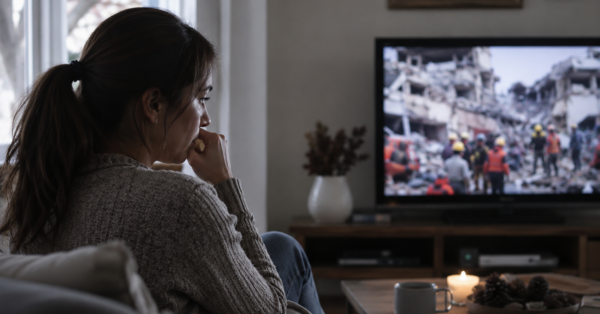
What is happening in Venezuela moves us, hurts us, and traverses us. The images of rescues, the testimonies of those who lost everything, the desperate search among the rubble, and the tireless work of the rescuers not only inform: they also emotionally impact those who watch from afar.
In a present marked by the World Cup, the shared joy of football and that sense of unity that arises when a national team brings a country together, the Venezuelan tragedy confronts us with a reality hard to process: life can hold, at the same time, celebration and loss, encounter and desolation, hope and pain.
On this double movement reflected Dr. Verónica Molina Gerstner, a cardiologist and specialist in psychotraumatology, who shared a sensitive view on how what we see, hear, and feel in the face of a collective catastrophe affects us.
“What is happening in Venezuela remains very concerning and, above all, invites us to come into contact with a experience of collective trauma that is taking place in this present,” she stated.
The emotional impact of watching a tragedy from afar
The specialist focused on a key question: what happens to us when we watch the news. Because it’s not just about consuming information. Each image of a person rescued, each account of a family searching for someone, every scene of destruction or active help stirs something in our inner world.
“We can recognize what happens to us when we watch these news reports, when we hear so many accounts of rescue experiences, encounters, as well as all the help that is mobilized around the world to accompany the Venezuelan people,” Molina Gerstner noted.
According to her explanation, these scenes can awaken anxiety, sadness, fear, helplessness, or a deep need to help. They can also generate the opposite: disconnection, emotional blockage, or a sense of unreality.
And that reaction, far from being indifference, is often a form of defense.
When collective pain coexists with joy
One of the deepest points of her reflection concerns the coexistence of seemingly opposing emotions.
While Venezuela faces a critical situation, the world is also watching the World Cup. For many Argentinians, football brings joy, belonging, connection, and a sense of shared identity.
“We are in a moment where, on one hand, we are all attentive to what happens in football, in the World Cup. It is an event that also brings joy, it brings connection with compatriots,” she expressed.
She added that this experience can bring us together “beyond political, religious, cultural, or social differences.”
But at the same time, that celebration coexists with “death, loss, and desolation” left by the earthquake.
“Just as life offers us this double map: on one side, being in the celebration and in the game, and on the other side, death, loss, and desolation,” she reflected.
That sentence sums up a very human experience: we do not always feel just one thing. Sometimes we laugh and we worry on the same day. We celebrate a goal and, minutes later, news breaks our soul. Emotional life is not linear: it is complex, contradictory, and deeply human.
The importance of self-regulating in the face of the news
In the face of large-scale tragedies, Molina Gerstner highlighted the importance of not remaining “adrift in the news.”
Overexposure to painful images can generate emotional saturation. Watching rescue, destruction, or suffering scenes over and over can lead us to a permanent state of alert, intense distress, or even disconnection.
“Perhaps what we see in those images and the human suffering there overwhelms us,” she warned.
That is why the specialist suggests recording what we feel and finding ways to self-regulate. This does not mean looking away or denying others’ pain. It means being able to accompany emotionally without destroying ourselves in the attempt.
Feeling, getting emotional, crying, or being moved also speaks to our empathetic capacity. But if the impact overwhelms us, it may be necessary to pause, breathe, talk to someone, limit exposure, or seek a concrete way to help.
When we disconnect from the pain
The doctor also invited us to notice something often accompanied by guilt: disconnection. Sometimes, in the face of a huge tragedy, a part of us shuts down. We cannot watch anymore, we cannot feel anymore, we cannot process anymore. And that disconnection also deserves to be heard.
“Being able to feel and find our capacity to process those emotions or realizing, also, to perceive when we disconnect. And that is a moment to reflect: why do I disconnect?” she asked.
That question opens a door. Perhaps we disconnect because the pain is too great. Because it touches a personal history. Because it reminds us of family losses. Because it triggers old memories. Or because, simply, our emotional system needs to protect itself.
Collective trauma and family memories
In her reflection, Molina Gerstner also proposed looking beyond the present. Collective tragedies, she explained, can resonate with family histories of wars, forced migrations, earthquakes, losses, or displacements.
“We can think of the stories of collective trauma from which our ancestors come,” she noted.
And she recalled, for example, historic earthquakes in Argentina, such as in San Juan or Mendoza, in addition to contexts of forced migration and wars.
Not all collective traumas have the same origin. It is not the same a natural disaster as violence caused by human beings. But in both cases fear, loss, insecurity, uncertainty, and the urgent need to survive can appear.
That is why what happens far away can also touch something close. An image of people fleeing, a family that loses everything, or a child waiting to be rescued can trigger personal or inherited emotional memories.
The life drive amid the rubble
In the midst of so much pain, the specialist also highlighted something profoundly human: the force of life.
Molina Gerstner referred to those images in which people trapped, even children, continue helping the rescuers, guiding them to reach others, even as they themselves wait to be saved.
“That life drive, that drive to care, to help, is in us and makes us human. It is such a valuable place, a treasure to protect,” she stated.
And perhaps there lies one of the brightest keys amid the tragedy: even when everything seems lost, people seek to care, sustain, accompany, point a path, help another.
That humanity that threads its way through the rubble also moves us because it reminds us of something essential: we are not made only of fear. We are also made of connection, solidarity, compassion, and a desire to live.
Looking with empathy, without getting trapped in horror
What is happening in Venezuela hurts. And it is important to allow ourselves to feel that pain. But it is also necessary to learn to look without getting trapped in horror.
We can inform ourselves, feel, pray, help, share reliable resources, accompany those near the Venezuelan community, and at the same time take care of our own emotional world.
Because empathy does not mean breaking ourselves. It means remaining human.
In the words of Dr. Verónica Molina Gerstner, these experiences invite us to recognize what happens to us, to record our emotions, and to continue walking together.
In times when joy and pain coexist, perhaps the challenge is this: not to deny either. To celebrate what unites, to be moved by what hurts, and to care, in the middle of all, for that life drive that still saves us.
More info: www.traumatrifocal.com/ IG: @icft_draveronicamolina