
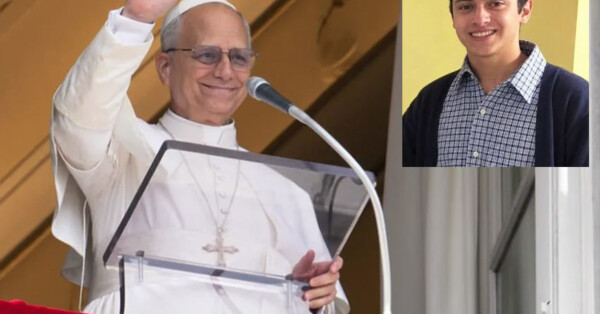
There are stories that seem to form from small events which, over time, come to acquire an unexpected meaning. The story of Tomás Valentín Gómez, a 27-year-old from Merlo, San Luis, is one of those.
When he was a child, his maternal grandfather took him to Mass on weekends. At five years old he began helping as an altar server at his parish and he was captivated by the colors, the embroidery and the vestments that priests wear during religious celebrations.
What started as a childish curiosity eventually became his vocation. Today, that boy who watched the altar garments closely has an extraordinary responsibility: to craft the liturgical garments that Pope Leo XIV will wear during his visit to Argentina, scheduled for November 2026.
From San Luis, Tomás is working against the clock on the creation of mitres, chasubles, stoles, and a pluvial cape that the Pontiff will don during various ceremonies in Buenos Aires and Córdoba.
And behind each of those garments lies a deeply personal story, shaped by faith, family memories, and a craft he learned through self-teaching.
From the sewing machine his mother gave him to dressing the Pope
Tomás’s relationship with sewing began long before he imagined one day making garments for a pontiff. In his parish, a sacristan was in charge of preparing the vestments for the celebrations. He started watching how she worked and, gradually, became curious about the materials, techniques, and sewing details.
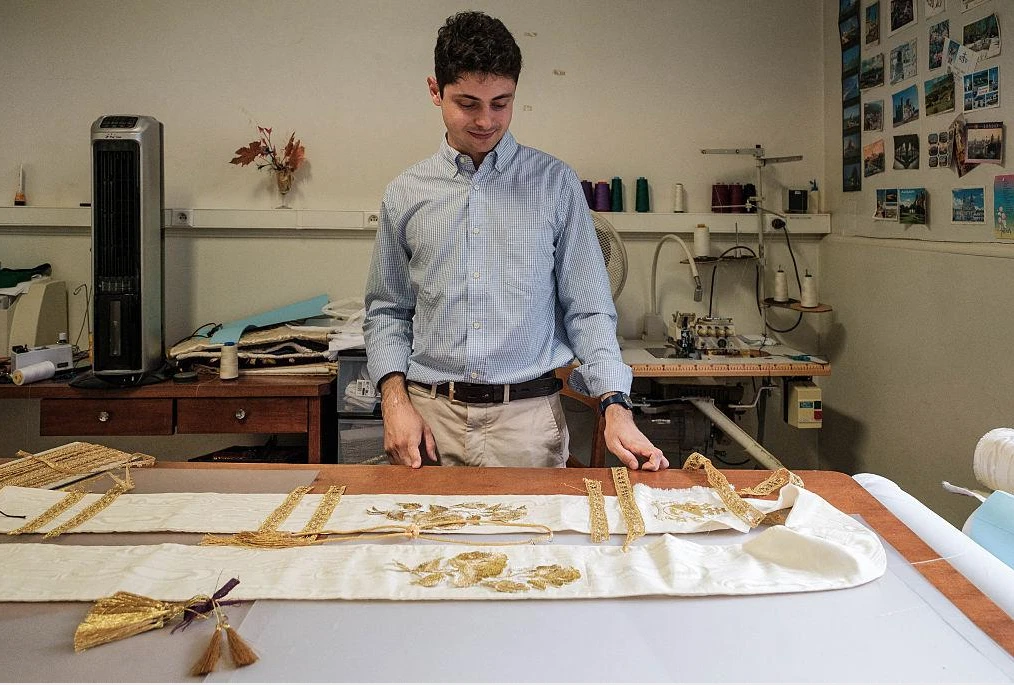
In 2016, when the parish needed new ornaments, he offered to help. But the turning point came in 2019, when his mother gave him his first sewing machine.
Tomás never took a formal sewing course. He learned by watching, practicing, and perfecting his techniques with each new project. At first he made garments for known priests. Later, commissions began to come from different Argentine provinces, including Córdoba, La Rioja and Buenos Aires.
Over time he created his own sacred art project, which he named Joseph, inspired by Saint Joseph, the carpenter of Nazareth. The choice of the name was not accidental: for Tomás, manual work can also be a way of expressing faith and placing personal talent at the service of others.
The Lourdes trip that changed his life
The story took an unexpected turn when Tomás began to travel to France. In 2019 he visited the Sanctuary of Our Lady of Lourdes, one of the world’s most important Catholic pilgrimage centers. Years later, in 2025, he returned as a volunteer. He intended to stay only two weeks, but he ended up remaining for several months.
There he assisted with the care of Spanish-speaking pilgrims, participated in various rites, and played the organ during Masses in Spanish and Italian. In another stay, during 2026, a proposal arrived that he had never imagined.
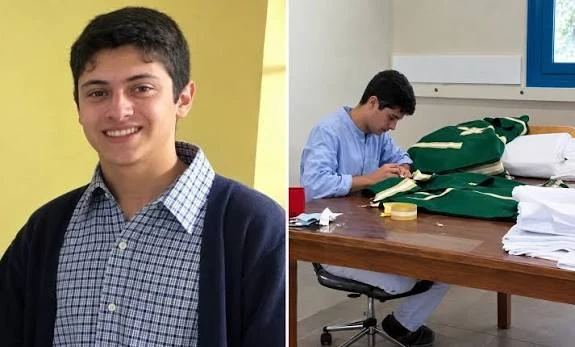
The sanctuary’s liturgical leaders invited him to help prepare the vestments that Leo XIV would wear during his visit to Lourdes. Tomás joined the workshop alongside Sor Martha Santos, a Mexican nun in charge of the sanctuary’s tailor shop. The challenge included making different garments for the Pontiff and other participants in the ceremonies.
In September, he finally got to see Leo XIV wearing the vestments they had prepared. One of the most special moments was when the Pope received a white stole sewn by Tomás, whose finishing touches were completed just two hours before his arrival.
For the young man, that experience carried a very deep meaning: the work he had begun in a parish in San Luis reached one of the most important religious celebrations of his life.
Thus the vestments Tomás makes for Pope Leo XIV in Argentina will be
Back in San Luis, the artisan faces a new challenge: to prepare the ornaments Leo XIV will wear during the celebrations planned in Buenos Aires and Córdoba. For the Buenos Aires events, he is crafting two mitres, a chasuble with its stole, and a pluvial cape accompanied by another stole.
The Córdoba set will include a chasuble, a mitre, and a stole, in addition to a red stole for a gathering with clergy and consecrated individuals at the cathedral. Each piece requires meticulous sewing and embroidery work, as well as respecting the distinctive features of liturgical attire.
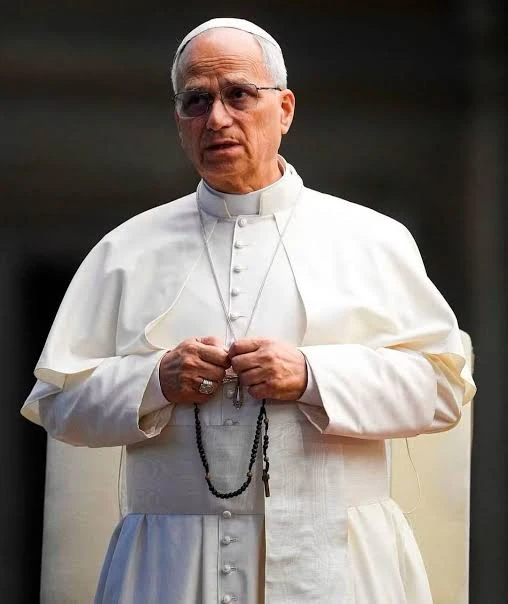
One of the most curious details is that the measurements were obtained through the Office of the Holy Father’s Liturgical Celebrations. Among them, a particularly crucial one: the circumference of the Pope’s head is 59.5 centimeters, a key datum for making the mitre, the ceremonial headgear worn by bishops.
“It’s the most delicate piece, because it has to fit precisely,” Tomás explained during an interview with Radio Mitre.
Light fabrics, embroidery, and colors: the details of the papal design
The making of these garments must also consider Argentina’s weather in November. For that reason, Tomás chose light fabrics, with a high cotton content and no polyester, aiming to keep the ornaments fresh and comfortable during the ceremonies.
Regarding the design, white will be the predominant color, accompanied by embroidery and details that will differentiate the sets destined for each city.
For Buenos Aires, the proposal includes golden and ochre tones. In contrast, the set planned for Córdoba will add details in gold, brown, and blue.
Beyond aesthetics, the colors and symbols of these garments carry meaning within Catholic tradition. White is used especially in celebrations connected with joy, glory, and the festivities of Christ, while red is associated, among other liturgical meanings, with the Holy Spirit and with martyrs.
The combination of fabrics, embroidery, and symbols makes each liturgical ornament a piece where religious tradition and artisanal craft intertwine.
Three weeks to craft the Pope’s garments
Another major challenge Tomás faces is time. While in Lourdes he had about two months to prepare the vestments, in Argentina he must complete the work in just three weeks.
The task involves coordinating the sewing of multiple pieces, checking measurements, and finishing all details before the celebrations. Yet the young man maintains a simple view of the responsibility he has assumed.
Although he has been invited to participate in the Buenos Aires and Córdoba activities, he does not take for granted that he will personally greet Leo XIV. His priority is to finish the garments and contribute his work to the team charged with organizing the ceremonies.
The emotion of a young man who met Pope Francis and will dress Leo XIV today
Tomás’s connection with the Vatican also has another special chapter. In 2019, during a service experience in Rome, he had the chance to meet Pope Francis.
As he recalled in an interview with TN, when he stood before the Argentine Pontiff he told him in a spontaneous moment that they shared the same nationality. Francis replied with humor, surprised to find another Argentine working there. That encounter stayed imprinted in his memory.
Today, seven years later, Tomás is part of a new church-related experience: preparing the garments that Leo XIV will wear during his visit to the country. And although his story seems extraordinary, there is something he emphasizes: behind every piece there are all the people who have accompanied and encouraged him since he was a child. Especially his grandparents.
His maternal grandfather, who passed away when Tomás was only four, was the one who brought him to mass and sparked his interest in liturgy. Over the years he also lost his paternal grandparents, but he keeps their teachings and remembers them in small everyday gestures.
In a sense, that family history is also present in the garments he now crafts. Because behind the young man who will clothe the Pope there is a boy who attended mass hand in hand with his grandfather, a mother who gave him a sewing machine, and a passion that grew stitch by stitch.
A story that demonstrates how a handcrafted trade, when it meets vocation and perseverance, can open paths that once seemed unimaginable.